



Best Large-Format Tile Manufacturers in India for Export Projects
Large-format porcelain slabs in sizes such as 800x1600 mm, 1200x1800 mm and 1200x2400 mm now make up one of the fastest-growing segments in Indian tile exports, driven chiefly by demand from the United States and the Middle East, per Construction Estimator India's 2026 export review. India's ceramic tile market is expected to reach 11.3 billion US dollars in 2026, growing at 8.12 percent a year through 2031, according to Mordor Intelligence, with large-format porcelain slabs identified as a specific growth driver within that figure.
Not every factory that lists large-format sizes on a catalogue can actually deliver them at export scale without warpage, shade variation or breakage in transit. This piece sets out the criteria that separate export-ready large-format manufacturers from factories still scaling into the segment, and where Rollence Granito fits against those criteria.
Kiln and Press Capacity Built for Large Slabs
Large-format tiles need continuous roller-hearth kilns and high-tonnage presses calibrated specifically for slab thickness and flatness, not the standard lines used for 600x600 mm production. Morbi's leading players have invested heavily here, with Somany Ceramics installing Sacmi Continua+ technology paired with a 58.8-metre horizontal dryer for its Somany Max large-slab line in 2023, and Varmora Granito committing roughly 48 million US dollars toward two new Morbi facilities in 2024, according to Markets and Data's 2026 report.
For an export buyer, the practical question is whether the factory quoting a 1200x1800 mm slab actually runs equipment sized for that format, or is subcontracting the run to a partner unit. Ask for the specific production line and press tonnage before confirming a large-slab order; this single question filters out a large share of catalogue-only suppliers.
Rectification and Calibration Consistency Across Batches
Large-format tiles are typically rectified, meaning the edges are precision-cut after firing to a tight tolerance, which matters more as size increases because even a 1 mm variance becomes visually obvious across a 1.8-metre slab. Export-grade manufacturers run automated sorting and calibration lines that batch tiles by exact shade and size before packing.
This is where reputation differs sharply between factories. A supplier that cannot demonstrate consistent rectification across a full container order will produce visible lippage on-site, which becomes the importer's problem months after the shipment has cleared customs and the factory has moved on to the next order.
Packaging Engineered for Long-Distance Freight
Large-format slabs travel 15 to 45 days by sea to most destinations, per Construction Estimator India, and breakage during that transit is the single most common complaint among first-time importers of Indian large-format tiles. Export-ready manufacturers use reinforced wooden crating with foam or corrugated interleaving specifically rated for slab weight and dimension, not the standard cardboard cartons used for wall tile shipments.
Rollence Granito builds crating specifications around the destination port and container type before confirming a large-format order, because the cost of re-shipping a damaged pallet erases any saving the buyer made on FOB price. Ask any shortlisted manufacturer to confirm their large-slab packing method before placing a deposit.
Design and Digital Printing Depth
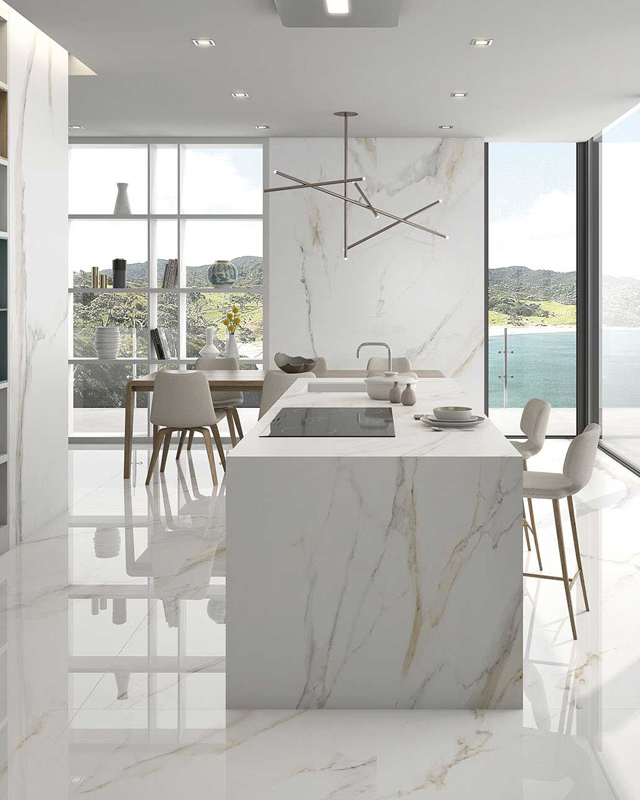
Large-format slabs are used disproportionately for feature walls, kitchen countertops and lobby flooring, which means the design has to hold up at close viewing distance across a much bigger visible surface than a standard 600x600 mm tile. Manufacturers running high-resolution digital inkjet printing on Sacmi or System Ceramics lines can reproduce marble veining and stone texture with far less visible pattern repeat across a slab run.
Rollence Granito specialises in GVT and PGVT slabs with an extensive marble-look and stone-look collection built specifically for large-format sizes, which matters because a design created for a small tile format often looks flat or repetitive when scaled up without re-engineering the print file.
Documented Compliance for Cross-Border Projects
Export projects, particularly commercial and hospitality builds, need documentation that survives architect sign-off and customs review at the same time: ISO 9001:2015 and ISO 14001:2015 certification, BIS slip-resistance ratings, and correct HS code classification, which became more consequential after the United States introduced elevated tariffs in 2025, per Scalane International's 2026 export guide.
A manufacturer that hands over accurate paperwork alongside the shipment saves the importer weeks of back-and-forth at customs. This is a genuine differentiator in the large-format segment, where a single delayed container can stall an entire project handover date.
What to Check Before Placing a Large-Format Order
|
Criteria |
Why It Matters |
Question to Ask the Factory |
|
Press and kiln capacity |
Confirms the slab is made on dedicated large-format lines, not subcontracted |
Which production line and press tonnage is this order running on? |
|
Rectification tolerance |
Prevents visible lippage across large surface areas |
What is your calibration tolerance across a full container batch? |
|
Packing specification |
Reduces breakage over 15 to 45 day sea freight |
What crating and interleaving do you use for this slab size? |
|
Certification |
Speeds customs clearance and project sign-off |
Can you share current ISO 9001, ISO 14001 and BIS test reports? |
The Line Between a Catalogue and a Capability
Large-format tile has become the segment where the gap between a factory that can produce a sample and a factory that can produce a container is widest. Kiln capacity, rectification consistency and packing discipline decide whether a large-slab order lands intact and on schedule, far more than the design catalogue does.
Rollence Granito's large-format GVT and PGVT lines, built around export packing specifications and ISO-backed quality control from its Morbi facility, are positioned specifically for buyers who have already been burned once by a factory that could not scale a sample into a full order.
Frequently Asked Questions: Best Large-Format Tile Manufacturers in India for Export Projects
What is considered a large-format tile in export markets?
Large-format generally refers to porcelain tiles or slabs from 800x1600 mm upward, including 1200x1800 mm and 1200x2400 mm sizes, used for feature walls, countertops and large-area flooring with minimal grout lines.
Why do large-format tiles cost more than standard sizes?
Large-format tiles require dedicated high-tonnage presses, longer kilns, tighter rectification tolerances and reinforced packaging, all of which add production and freight cost compared with standard 600x600 mm tile lines.
How do I avoid breakage when importing large-format slabs from India?
Confirm the manufacturer uses reinforced wooden crating with slab-specific interleaving rather than standard cardboard cartons, and ask for photos or video of a completed container load before the shipment departs the factory.
Are Indian large-format tiles suitable for commercial projects?
Yes. Indian manufacturers now run Sacmi, System Ceramics and Fintech equipment comparable to European lines, producing large-format GVT and PGVT slabs used in hotels, retail interiors and commercial lobbies across export markets.
What certifications should a large-format tile manufacturer hold?
Look for ISO 9001:2015 for quality management, ISO 14001:2015 for environmental management, and BIS test reports covering slip resistance and water absorption, alongside accurate HS code documentation for customs clearance.
Which large-format tile finishes are most requested for export in 2026?
Marble-look and stone-look glazed vitrified finishes lead export demand in 2026, particularly for hospitality and retail interiors, followed by matte and linen-textured finishes for large-area commercial flooring.

