



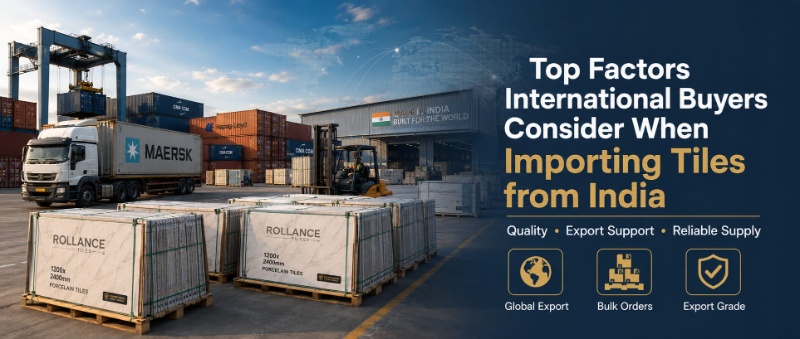
Top Factors International Buyers Consider When Importing Tiles from India
India has become one of the strongest tile export markets in the world. Buyers across the Middle East, Africa, Europe, and North America regularly source porcelain and vitrified tiles from Indian manufacturers because the industry now offers a strong mix of production scale, design variety, and export capability.
A large part of this growth comes from Gujarat, especially Morbi, where hundreds of factories manufacture tiles for both domestic and international markets. Over the last decade, Indian manufacturers have invested heavily in digital printing technology, automated production lines, and large-format tile manufacturing.
For international buyers, importing tiles from India is no longer only about lower pricing. Today, importers compare quality standards, production consistency, export support, packaging systems, and supplier reliability before making long-term sourcing decisions.
This guide explains the top factors international buyers consider before importing tiles from India and how experienced exporters build trust in global markets.
Why India Has Become a Major Global Tile Exporter
India’s ceramic industry has expanded rapidly over the last few years. Modern production facilities and growing export infrastructure have helped Indian manufacturers compete directly with suppliers from China, Spain, Turkey, and Italy.
The biggest advantage is scale.
Factories in Morbi and other manufacturing regions produce large volumes of:
- Porcelain tiles
- Vitrified tiles
- Large-format slabs
- Outdoor tiles
- Wall tiles
- Commercial flooring solutions
This large-scale production allows exporters to supply distributors, wholesalers, and commercial projects across multiple countries.
Indian tile exports continue to grow because manufacturers now focus not only on quantity but also on design quality and international market requirements.
What Makes Indian Tiles Competitive in International Markets
Manufacturing Technology
Modern tile factories in India use advanced production systems similar to global manufacturing standards.
These include:
- Digital printing technology
- Automated polishing lines
- High-pressure presses
- Large continuous kilns
- Rectified tile processing systems
These technologies improve:
- Surface finish consistency
- Tile sizing accuracy
- Production speed
- Design precision
This is especially important for large-format porcelain tiles where small production errors become highly visible during installation.
Wide Product Range
International buyers often prefer suppliers who can offer multiple tile categories under one roof.
Indian manufacturers now produce:
- Glossy porcelain tiles
- Matte vitrified tiles
- Natural finish tiles
- Anti-skid tiles
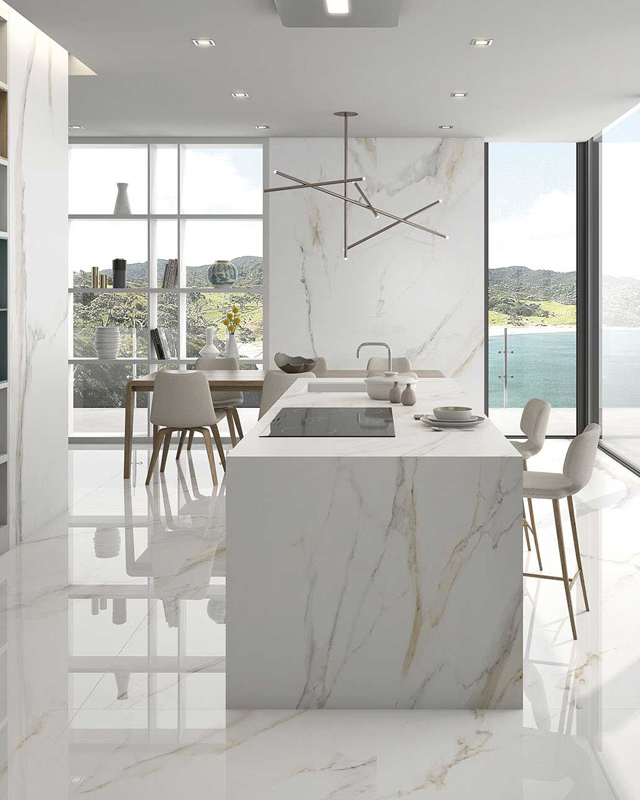
- Marble-look slabs
- Wood-look porcelain tiles
- Bookmatch large-format tiles
This helps importers reduce sourcing complexity.
Instead of managing multiple suppliers, buyers can often source different product lines from a single export partner.
Competitive Production Costs
India still maintains a cost advantage compared to many global markets.
Factors that support competitive pricing include:
- Local raw material availability
- Large manufacturing clusters
- Skilled workforce
- Efficient transportation access
This cost efficiency allows importers to maintain healthy margins without compromising basic quality standards.
Still, experienced buyers know that pricing alone should never be the main deciding factor.
Top Factors Buyers Evaluate Before Importing Tiles
1. Product Quality and Consistency
Quality is usually the first thing buyers evaluate.
A good-looking sample means very little if the bulk shipment does not maintain the same standard.
Importers commonly review:
- Surface finish quality
- Shade consistency
- Water absorption
- Tile calibration
- Edge finishing
- Gloss uniformity
Large commercial projects especially require consistency across thousands of square meters.
Even slight variation between batches can create visible flooring issues after installation.
Many buyers also review porcelain tile technical properties before approving production.
2. Manufacturing Capacity
Production capacity becomes critical for distributors and project buyers.
A supplier may offer attractive samples but struggle to deliver bulk quantities on time.
International buyers usually verify:
- Daily production capacity
- Number of production lines
- Large-format manufacturing capability
- Export order handling experience
Reliable production planning is essential for projects with fixed deadlines.
3. Tile Sizes and Product Availability
Global demand for large-format porcelain tiles has increased significantly.
Importers now frequently request:
- 600x1200 mm
- 800x1600 mm
- 1200x1200 mm
- 1200x2400 mm slabs
Manufacturers with wider size ranges generally attract more international buyers because they can support multiple market segments.
Availability across different finishes also matters.
Buyers often need matching collections in:
- Glossy
- Matte
- Natural finish
- Structured finish
4. Technical Specifications and Certifications
Technical performance matters more in export markets than many first-time buyers expect.
Importers commonly ask for:
- Water absorption reports
- PEI ratings
- Slip resistance details
- Breaking strength data
- Surface abrasion resistance
Export certifications also help build buyer confidence.
Common requirements include:
- ISO certification
- CE standards
- Export testing compliance
Professional exporters usually provide technical documentation quickly and clearly.
5. Packaging Standards
Packaging quality directly affects shipment safety.
Large-format porcelain tiles especially require strong packaging because slab damage during shipping can create major losses.
Buyers evaluate:
- Carton strength
- Pallet quality
- Edge protection
- Container loading systems
- Moisture protection methods
Good exporters focus heavily on packaging because damaged shipments create long-term trust issues.
6. Shipping and Logistics Support
Export operations involve more than manufacturing.
Experienced tile exporters help buyers with:
- Container optimization
- Shipping schedules
- Export documentation
- Freight coordination
- Port handling support
Strong logistics management reduces delays and improves delivery reliability.
This becomes even more important during large commercial supply projects.
7. Communication and Export Experience
One of the biggest differences between average and professional exporters is communication.
International buyers expect:
- Fast response times
- Production updates
- Clear order tracking
- Quick issue resolution
Poor communication often creates more problems than pricing or product issues.
Experienced exporters understand international business expectations and maintain structured communication throughout production and shipping.
8. Pricing Stability for Long-Term Business
Importers are not only buying products. They are building long-term supply relationships.
Sudden price fluctuations create problems for distributors who already committed pricing to customers.
Reliable manufacturers usually maintain:
- Better raw material planning
- Stable production systems
- Transparent pricing structures
Long-term buyers often prioritize consistency over extremely low prices.
Common Problems Faced by Tile Importers
Batch Variation Issues
One of the most common problems is inconsistency between production batches.
This affects:
- Shade matching
- Surface texture
- Gloss levels
- Tile sizing
Professional manufacturers use better quality control systems to reduce this issue.
Shipping Damage
Weak packaging or poor container loading can result in damaged products during transit.
Large-format slabs are especially sensitive during international shipping.
Delayed Production Timelines
Production delays create major problems for commercial projects and distributors.
Buyers often prefer manufacturers with proven export scheduling systems.
Weak Export Communication
Lack of updates during production or shipping creates uncertainty for buyers.
Reliable exporters maintain consistent communication throughout the order process.
Expert Tips Before Finalizing a Tile Supplier
- Request technical data sheets before bulk orders
- Ask for recent export project references
- Review packaging methods carefully
- Confirm production capacity for repeat orders
- Test product consistency across multiple samples
- Verify export certifications and compliance documents
These small checks help buyers avoid expensive sourcing mistakes later.
Why Large Format Porcelain Tiles Are Growing in Demand
Large-format porcelain tiles are now one of the fastest-growing categories in international markets.
Architects and developers prefer them because they create:
- Seamless flooring appearance
- Fewer grout joints
- Modern visual appeal
- Premium commercial aesthetics
Large-format tiles are commonly used in:
- Luxury residential projects
- Hotels
- Corporate offices
- Airports
- Shopping malls
This growing demand has pushed many Indian manufacturers to invest heavily in slab production technology.
Why Choose Rollence Granito
Rollence Granito focuses on manufacturing export-grade porcelain and vitrified tiles designed for international markets.
The company offers:
- Modern manufacturing infrastructure
- Large-format porcelain solutions
- Consistent product quality
- Export-focused production support
- Multiple surface finishes and sizes
Its approach focuses on long-term buyer relationships, stable quality standards, and reliable export support for distributors, wholesalers, and commercial projects.
Final Thoughts
India has become one of the most important sourcing destinations for porcelain and vitrified tiles.
The industry now competes globally not only through pricing but also through manufacturing capability, design quality, and export infrastructure.
For international buyers, the right supplier is the one that can maintain consistency, support large-scale requirements, and build long-term trust through reliable export operations.
Looking for a Reliable Tile Export Partner from India?
Choosing the right supplier can make a major difference in product quality, delivery timelines, and long-term business growth. Working with an experienced manufacturer helps international buyers manage bulk orders more efficiently while maintaining consistent quality standards.
Rollence Granito offers export-grade porcelain and vitrified tiles designed for distributors, wholesalers, and commercial projects across global markets. From large-format collections to functional finishes, the company focuses on dependable supply, modern manufacturing, and professional export support.
If you are planning to import tiles from India for your next project or distribution business, exploring the right manufacturing partner is the first step toward building a stable and long-term supply network.
FAQ Section
Why do global buyers import tiles from India?
Global buyers prefer Indian tiles because India offers competitive pricing, strong production capacity, modern designs, and growing export quality standards.
What should importers check before placing tile orders?
Importers should review quality consistency, packaging systems, production capability, technical specifications, and export experience before finalizing suppliers.
How do buyers choose reliable tile exporters in India?
Buyers usually compare manufacturing quality, export support, communication, certifications, and long-term supply reliability before choosing exporters

