



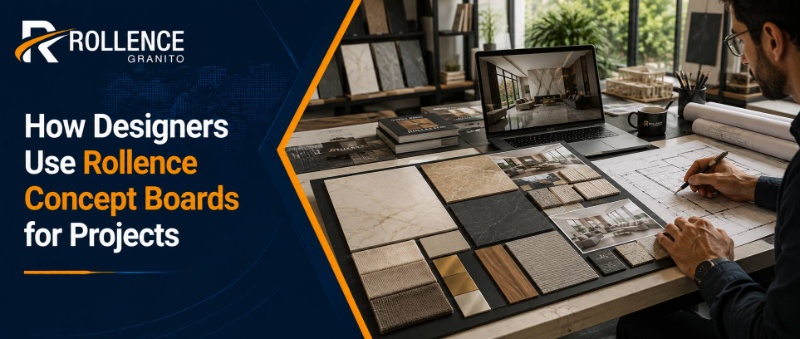
How Designers Use Rollence Concept Boards for Projects
Choosing one good tile is easy. Making an entire project, floors, walls, kitchen, and bathrooms, feel like one scheme is the hard part.
This is where concept boards earn their place. Designers use them to group compatible tiles before ordering a single box, so nothing clashes on site.
This guide explains how designers use Rollence concept boards for projects, and why this planning step saves both time and money. It sits under our pillar on tile design ideas for modern homes and commercial spaces.
What a Concept Board Actually Is
A concept board is a curated set of tiles chosen to work together across a project. It pulls floor, wall, and feature tiles into one place so you can judge them side by side.
Instead of picking tiles room by room in isolation, a concept board lets you see the whole scheme at once. That is how you catch a clash before it becomes a floor.
For a project, a board usually brings together a lead floor colour, a supporting wall tile, one or two feature surfaces, and the finishes for each.
Why Concept Boards Save Projects
Most tile problems come from decisions made in isolation. A grey chosen in the bathroom showroom can fight the beige picked for the living room weeks earlier.
A concept board removes that risk by forcing every choice into one view. It gives three clear benefits.
-
It keeps colours and finishes consistent across every room.
-
It catches clashes on paper, not on an expensive finished floor.
-
It speeds up client approval, since everyone sees the full scheme at once.
For architects and contractors juggling many rooms, this single view is what keeps a large project on track.
How the Rollence Range Supports Concept Boards
Rollence organises its porcelain into clear series and finishes, which makes board-building straightforward. You start with a series family and stay within it for a coherent look.
The series include Statuario, Grey/Silver, Beige/Crema, Onyx, and Natural. The finishes include Glossy, High Gloss, Natural, Marble, and more.
Because these are grouped, a designer can pick a beige lead floor and know which walls and features already sit well with it. As one of the established large-format porcelain tiles manufacturers in Morbi, Rollence supplies the full range in matching sizes so a board translates cleanly into an order.
Building a Concept Board Step by Step
The process follows the same order as good tile design: size, then finish, then colour. A board built in this order rarely falls apart on site.
-
Pick the lead floor tile, since it is the largest surface and sets the base.
-
Choose the wall tile to support, not compete with, the floor.
-
Add one or two feature surfaces, such as an Onyx or Statuario accent.
-
Set the finish for each surface, matching grip and shine to the room.
-
Check the full board in daylight before locking it.
If you are unsure which colours belong together, our guide on tile colour psychology for interior spaces explains how each colour family behaves.
Using the Tiles Visualizer With Your Board
A physical board tells you the colours and finishes. A visualizer tells you how they look on a real room layout.
Rollence offers an online tiles visualizer that lets you apply the tiles to sample rooms. This helps clients see the scheme on a floor and wall, not just as loose samples.
Pairing the concept board with the visualizer gives clients confidence, which speeds up sign-off and reduces late changes.
Concept Boards for Different Project Types
The board changes with the project. A home board and a commercial board have different priorities.
|
Project type |
Board focus |
Typical lead |
|---|---|---|
|
Residential home |
Warmth, flow between rooms |
Beige or light grey |
|
Office / corporate |
Clean, formal, ordered |
Grey / silver |
|
Retail / showroom |
Bright, premium, hard-wearing |
Light neutral, glossy |
|
Hospitality |
Mood, richness, comfort |
Onyx, Statuario |
For large export projects, boards often lead with big formats to keep floors continuous. Rollence supports these as a 1200x1800 porcelain tiles manufacturer in iraq, supplying slab-scale surfaces that suit feature walls and lobbies.
Turning a Board Into an Order
Once the board is approved, it becomes the order sheet. Every surface on the board maps to a size, series, and finish.
Order all tiles for connected rooms from the same production batch, so shades match. Add 5 to 10 percent extra per tile for cuts, wastage, and future repairs.
This is also where boards save money. Because the scheme is locked, there are fewer wrong orders and less material sitting unused.
Common Concept Board Mistakes
A board only works if it is built with care. These slips undo its value.
-
Picking tiles room by room and building the board afterwards, which defeats the point.
-
Mixing too many series, so the scheme loses its coherence.
-
Judging the board only under showroom light, not daylight.
-
Forgetting to note the finish for each surface, which changes grip and safety.
-
Approving a board without checking sizes are available in matching formats.
Planning Smarter With Concept Boards
A concept board turns a scattered set of tile choices into one clear scheme. It is the single step that keeps a project consistent from the first room to the last.
Rollence Granito organises its porcelain into series and finishes that make board-building simple, backed by an online visualizer. Explore the range on the Rollence website and request samples to start building your project board.
Frequently Asked Questions
What is a tile concept board?
A concept board is a curated set of tiles, floor, wall, and feature, chosen to work together across a whole project before any tiles are ordered.
Why do designers use concept boards?
They keep colours and finishes consistent across rooms, catch clashes early, and speed up client approval by showing the full scheme at once.
How do I start a concept board?
Start with the lead floor tile, then add supporting wall tiles and one or two features, and set the finish for each surface.
Does Rollence have a tiles visualizer?
Yes. Rollence offers an online tiles visualizer that lets you apply tiles to sample rooms, which helps clients see the scheme before ordering.
How many tile series should one project use?
Usually one or two series keep a project coherent. Too many series make the scheme feel disconnected.
How much extra tile should I order from a board?
Order 5 to 10 percent extra per tile from the same batch, to cover cuts, wastage, and future repairs with matching shades.

