Hi there 👋
Need help? Search our help center for answers or start a conversation:
Help Center
New Conversation
We typically reply in a few minutes
 Customer Support
Select Emoji
Quick Enquiry
We'll get back to you within 24 hours

No products found.
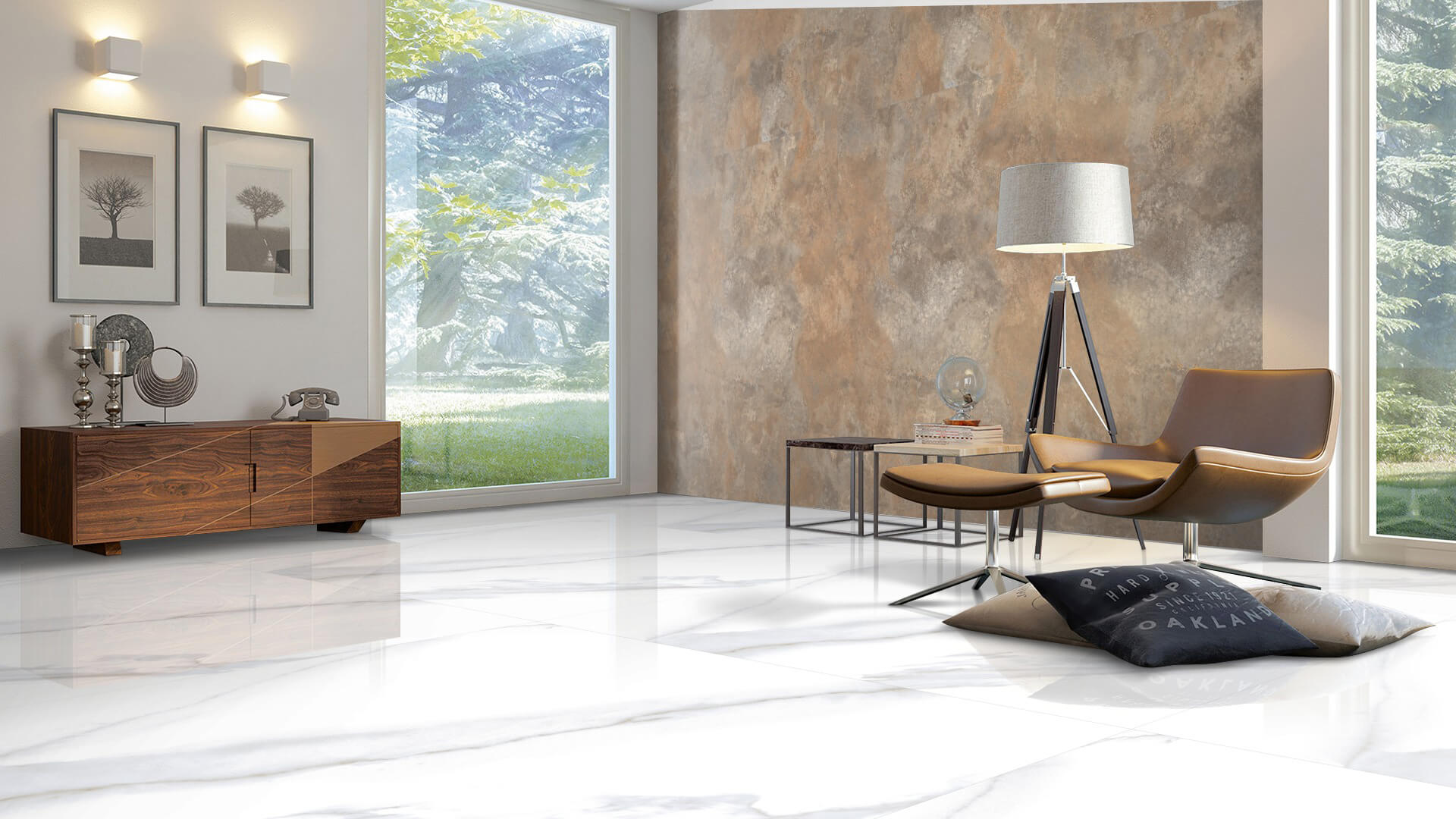
← View all productsMarble finish tiles copy the veins, clouds and colour shifts of natural marble on a tile body that does not stain, crack along the grain or need sealing. The pattern is printed digitally under a hard glaze, which is why a tile can look like a Carrara or a Statuario at a fraction of the cost. Rollence lists Marble as one of its finishes, in GVT for floors and walls and in PGVT for walls, made at its factory in Matel, Wankaner, Morbi, Gujarat, as part of its porcelain tile range.
Marble is one of eight Rollence finishes, next to DG Matt, Glossy, High Gloss, DG Matt + Carving, GHR + Punch, GLR and Papermatt. Marble finish vitrified tiles can be matt or shiny depending on the design, so the finish name tells you the look and not the sheen. The site lets you filter the design list by finish. Every tile absorbs 0.5% water or less.
In the Morbi market, marble finish GVT sells at about Rs. 60 to Rs. 140 per sq.ft and PGVT at Rs. 70 to Rs. 180 per sq.ft, so one 600x1200 mm (2x4 ft) GVT tile costs about Rs. 470 to Rs. 1,100. These are market reference ranges and not a Rollence quote. Larger formats cost more, and big sizes across the Indian market run from about Rs. 150 to Rs. 600 per sq.ft.
A marble finish tile is a printed tile, not a cut stone. The vein pattern is applied by digital printing, then sealed under a glaze, so every tile in a box can be printed to look different. That is the reason designs avoid obvious repeats, and why a floor can look like one continuous stone.
Under the print sits the same dense body used across the range. Whether buyers call it GVT, vitrified or porcelain depends on the size, and the difference between porcelain and vitrified tiles is worth knowing before you ask a dealer for either. The body takes in 0.5% water or less, so spills do not leave stains the way they do on real marble.
These two sit at opposite ends of the buying question. Marble is chosen for how the room looks. GHR + Punch is chosen for how the floor grips. A marble look in a bathroom is common, but the design must be a textured, rated one if it goes on the floor, and a smooth marble look tile is a wall tile or a dry floor tile.
| Point | Marble | GHR + Punch |
|---|---|---|
| Chosen for | The look of marble | Grip on wet floors |
| Surface | Smooth print, sheen varies | Raised relief texture |
| Bathroom floor | Only a rated, textured design | Yes, once the design is rated R10 or R11 |
| Living room floor | Yes, in dry rooms | Not the usual choice |
A shiny marble finish should not be used on bathroom, balcony or terrace floors because it turns slippery when wet. PGVT should not be used on any floor.
The sheen decides where the tile can go. A matt marble look, like Carrara matte, hides footprints and suits a living room that is used every day. Glossy marble tiles lift the veining and reflect light, which suits a dry lobby, and they need the same care as any other shiny floor. Check the sheen on each design sheet before ordering.
For a start, look at the Marbella collection, the marble look range in the Rollence catalogue. Many designs copy Italian marble finish tiles such as Carrara, Calacatta and Statuario, in white and grey with fine veins, and in darker tones with bold veins.
Real marble is a soft, porous stone. It stains with oil, turns dull under acid cleaners, and needs polishing and sealing every few years. A marble finish vitrified tile has a hard glaze and a body that absorbs 0.5% water or less, so it keeps its look with a damp mop. In a Gujarat monsoon, humid air and wet shoes do not mark it.
The price gap is large. Real marble is priced by the stone and the finish, while a marble finish tile sells at Rs. 60 to Rs. 140 per sq.ft in GVT, and laying labour adds Rs. 15 to Rs. 60. For most Indian homes the tile gives the same look with far lower upkeep.
Veins read best on large tiles, because a longer tile carries more of the pattern before a joint breaks it. A 1200x1800 mm tile of 23.3 sq.ft needs only 47 pieces per 100 m², with a grout run of about 139 m. It is sold as large format GVT and PGVT, and across the Indian market a tile this size costs about Rs. 3,500 to Rs. 14,000 each at Rs. 150 to Rs. 600 per sq.ft.
Smaller tiles still work. A 600x1200 mm tile gives a good vein flow in a living room, and book-matched layouts, where two tiles mirror each other, need tiles from the same batch and a careful lay-out plan.
Match the grout to the lightest vein colour, so joints disappear instead of drawing a grid on the floor. Use epoxy grout in any wet area and near a kitchen, because white cement grout picks up stains. Sweep grit before mopping, and use a neutral cleaner with a microfibre mop.
Each design has its own sheet in the design catalogues, with the sheen, sizes and recommended use. Use the sheet as the final check before the order goes in.
Marble veining looks different in daylight and under lamps, so see a full tile and not only a swatch before you fix the design. Rollence Granito will deliver free samples to your door, and then quote for the size, collection, quantity and city you give it through the enquiry form.
A 600x1200 mm (2x4 ft) marble finish GVT tile from the Morbi market costs about Rs. 60 to Rs. 140 per sq.ft, roughly Rs. 470 to Rs. 1,100 per tile, and 139 tiles cover 100 m². The body absorbs 0.5% water or less. PGVT costs Rs. 70 to Rs. 180 per sq.ft and is for walls only. These are market ranges, not a Rollence quote.
Marble finish tiles stand up to a Gujarat monsoon indoors, because the body absorbs 0.5% water or less, the BIa limit under IS 15622, and the glaze resists stains. A 1200x1800 mm (4x6 ft) tile is a large format size sold as GVT and PGVT. Morbi GVT starts at Rs. 60 to Rs. 140 per sq.ft, and epoxy grout seals the joints.
Marble finish tiles are printed tiles that copy the veins and colours of natural marble. The pattern is applied digitally under a hard glaze on a dense GVT or PGVT body. They give the look of marble without the staining, sealing and polishing that real stone needs.
They can be either, because the sheen depends on the design. Some marble designs are matt, such as Carrara matte, and others are shiny. Check the sheen on the design sheet before ordering. A shiny marble finish should never be used on wet or outdoor floors.
Yes, on walls, in any sheen. On the floor, only use a textured design rated R10 or R11, because a smooth marble finish is slippery when wet. Use GVT for floors, since PGVT is a wall tile, and seal every bathroom joint with epoxy grout.
For most homes, yes, because they do not stain, dull or need sealing. The body absorbs 0.5% water or less, so oil and water stay on the surface. Real marble offers a unique natural pattern, but it costs far more and needs regular polishing.
Marble finish GVT costs about Rs. 60 to Rs. 140 per sq.ft in the Morbi market. PGVT costs Rs. 70 to Rs. 180 per sq.ft. Large formats cost more, at roughly Rs. 150 to Rs. 600 per sq.ft. Prices change with design, size and city, and they are not a Rollence quote.
Large tiles show the veining best, because fewer joints break the pattern. A 600x1200 mm tile suits most living rooms, and sizes from 1200x1800 mm suit lobbies and big halls. Sizes of 1200x1800 mm and above are sold as large format GVT and PGVT.
Sweep grit first, then mop with a neutral cleaner and a microfibre cloth, and dry the floor. Avoid acid cleaners, which attack grout and dull shiny glazes. Use epoxy grout in wet areas, mats at entrances and felt pads under furniture to prevent scratches.
Product Inquiry
Fill in your details and we'll get back to you