



Exporting Tiles from India to the Middle East: Trends, Sizes and Demand
Gulf Cooperation Council countries once accounted for 35 to 40 percent of India's total tile exports and remain one of the most consistent destinations for Indian tile shipments, according to TreeTile's 2026 country analysis. The Middle East and Africa region contributed 19 percent of the global ceramic tiles market in 2025, valued at 16.78 billion US dollars, and is projected to reach 17.45 billion dollars in 2026, per Fortune Business Insights.
Israel alone saw a 146 percent spike in tile imports from India, driven by an active housing boom and urgent construction timelines, per TreeTile's 2026 data. For exporters and importers on both sides of that trade route, understanding which sizes, finishes and duty structures are actually moving product in 2026 matters more than a generic pitch about India's low cost.
Why GCC Demand Keeps Growing Regardless of Oil Cycles
Construction activity across the GCC continues expanding at over 5 percent year on year even through periods of regional volatility, driven substantially by government infrastructure investment as oil-dependent economies diversify into tourism, logistics and manufacturing, according to Technavio's GCC ceramic tiles analysis. Hotels, malls, airports and housing developments in the region run construction pipelines that do not pause the way private residential renovation cycles do elsewhere.
This is the structural reason Indian exporters treat the Middle East as a base-load market rather than an opportunistic one. UAE, Iraq and Oman all sit in the top 11 countries importing tiles from India, and Saudi Arabia has historically ranked among India's top five destinations for years at a time, per TreeTile's 2026 report.
CEPA Duty Benefits Change the UAE Sourcing Calculation
Under the India-UAE Comprehensive Economic Partnership Agreement, tile exports into the UAE and broader GCC carry zero import duty, a direct structural advantage over exporters from countries without an equivalent trade agreement in place, per Construction Estimator India's 2026 review. For an importer comparing Indian, Chinese, Spanish and Turkish quotes on an identical specification, that duty gap alone can outweigh a modest FOB price difference.
This advantage sits on top of India's already competitive freight position: Morbi-based exporters ship through Mundra and Kandla ports with transit times of 15 to 45 days to most Gulf destinations, keeping total landed cost meaningfully below comparable European alternatives.
Anti-Dumping Measures Are Reshaping, Not Shrinking, the Trade Route
Saudi Arabia and Qatar have both introduced anti-dumping duties on Indian ceramic tiles at various points, which has pushed some Morbi exporters to diversify shipment destinations across the wider GCC and beyond, per Mordor Intelligence's 2026 market report. This has not reduced total Middle East volume so much as redistributed it, with UAE, Iraq and Oman absorbing a larger share of the flow that once concentrated more heavily in Saudi Arabia alone.
Exporters who track destination-specific duty exposure, rather than treating the GCC as a single uniform market, are the ones adjusting fastest. A shipment routed to the UAE under CEPA terms and a shipment destined for a market with active anti-dumping measures need entirely different documentation and pricing strategy from the outset.
Large-Format Slabs Are the Fastest-Growing Size Category
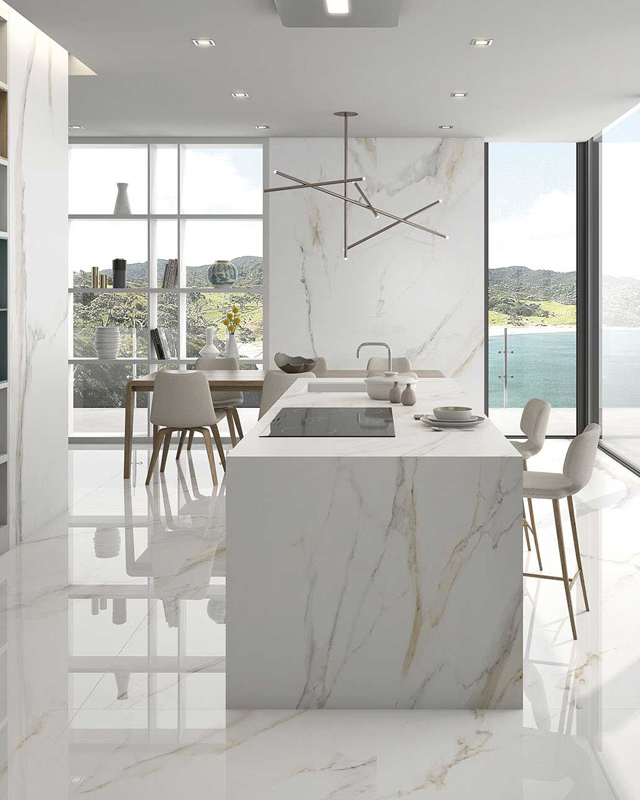
Large-format porcelain slabs are in particularly high demand for luxury interiors and kitchen countertops across both the United States and the Middle East in 2026, per Construction Estimator India, with 300x600 mm, 400x800 mm and increasingly 800x1600 mm-plus sizes moving fastest into Gulf projects. High-end hospitality and residential towers across the UAE and Saudi Arabia are specifying fewer grout lines and larger visual spans, which only large-format porcelain can deliver at export-viable cost.
Rollence Granito's GVT and PGVT large-format range, engineered on Morbi's calibrated production lines, is built around exactly this demand pattern, giving Middle East importers a source that matches both the size trend and the marble-look and stone-look design direction dominating current Gulf interior specification.
Design Preferences Are Shifting Toward Marble and Stone Replication
Middle East buyers continue to favour marble-look and travertine-look porcelain finishes, reflecting both regional aesthetic preference and the practical need for a durable, lower-maintenance alternative to natural stone in high-traffic commercial developments. Digital inkjet printing on Sacmi and System Ceramics equipment has closed most of the visual gap between porcelain and natural stone, which matters directly in a region where natural marble remains a strong design reference point.
For importers, this means the design catalogue matters as much as the price sheet when shortlisting a supplier for Gulf-bound projects. A manufacturer with a shallow marble-look range will lose the specification stage regardless of how competitive the FOB quote is.
Middle East Tile Export Snapshot for Indian Manufacturers
|
Factor |
Current Position |
What It Means for Buyers |
|
GCC share of Indian tile exports |
35 to 40 percent historically |
Consistent, high-volume demand base |
|
UAE import duty under CEPA |
Zero import duty |
Direct landed-cost advantage over non-CEPA origins |
|
Sea freight transit time |
15 to 45 days via Mundra and Kandla |
Predictable delivery windows for project schedules |
|
Fastest-growing size segment |
Large-format slabs 800mm+ |
Fewer grout lines specified for hospitality and luxury interiors |
The Middle East Route Rewards Specificity, Not Generic Sourcing
Treating the Middle East as one undifferentiated export market is the fastest way to misprice a shipment or misjudge a duty exposure. UAE, Saudi Arabia and the wider GCC each carry different trade terms, different anti-dumping histories and slightly different design preferences, even while sharing the same broad appetite for large-format, marble-look porcelain tiles.
Rollence Granito ships into this route with duty structure, size trend and design direction treated as three separate variables rather than one generic pitch, which is the level of specificity Gulf-based importers are increasingly demanding before they commit to a repeat-order relationship.
Frequently Asked Questions: Exporting Tiles from India to the Middle East: Trends, Sizes and Demand
What percentage of India's tile exports go to the Middle East?
Gulf Cooperation Council countries have historically accounted for 35 to 40 percent of India's total tile exports, making the region one of the most consistent and high-volume destinations for Indian ceramic and porcelain tile manufacturers.
Do Indian tiles have a duty advantage in the UAE?
Yes. Under the India-UAE Comprehensive Economic Partnership Agreement, tile exports into the UAE carry zero import duty, giving Indian manufacturers a direct cost advantage over exporters from countries without a similar trade agreement.
Which tile sizes are most in demand in the Middle East right now?
Large-format porcelain slabs from 800mm upward, alongside standard 300x600 mm and 400x800 mm sizes, are seeing the fastest growth in Middle East demand, driven by hospitality and luxury residential specification trends in 2026.
Are there anti-dumping duties on Indian tiles in the Middle East?
Saudi Arabia and Qatar have both applied anti-dumping measures on Indian ceramic tiles at various points, which has shifted export volume toward the UAE, Iraq and Oman rather than reducing overall Middle East demand.
How long does tile shipping take from India to the Middle East?
Sea freight from Morbi-area exporters through Mundra and Kandla ports typically takes 15 to 45 days to most Gulf destinations, depending on the specific port and shipping line schedule.
Why do Middle East buyers prefer marble-look porcelain tiles?
Marble-look porcelain tiles replicate the aesthetic of natural stone, a strong regional design preference, while offering lower maintenance and better durability for high-traffic commercial and hospitality developments across the Gulf.

