



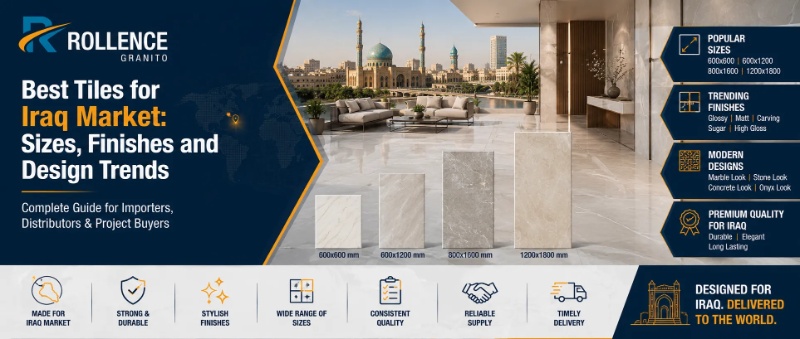
Best Tiles for Iraq Market: Sizes, Finishes and Design Trends
Iraq is one of the most active tile import markets in the Middle East. Construction activity across Baghdad, Basra, Erbil, Sulaymaniyah, and Najaf drives consistent demand for floor and wall tiles across residential villas, apartment blocks, commercial buildings, and hospitality projects. Local ceramic production exists but does not meet the volume or variety that contractors and developers require, which is why Indian, Iranian, and Chinese suppliers compete actively for the Iraqi market.
Among these, Indian porcelain tiles from Morbi, Gujarat have gained strong ground over the last decade. The combination of large-format sizes, marble and stone-look digital prints, and competitive FOB pricing makes Morbi tiles a practical choice for importers and project buyers in Iraq.
This guide covers what tile types, sizes, finishes, and design directions the Iraq market currently favours, and what specifications matter most for buyers and dealers sourcing tiles for Iraqi projects.
Understanding the Iraq Tile Market
Iraq's tile market operates through two main channels: project supply and retail distribution. Project supply caters to large-scale developments including government housing, private villa compounds, hotels, and commercial towers. Retail distribution serves individual homeowners, small contractors, and interior fitout companies.
Both channels have distinct preferences. Project buyers prioritise consistent supply, documented quality, and price predictability across large quantities. Retail buyers and smaller contractors lean toward visual appeal, trending designs, and accessible price points.
Key Cities and Their Tile Demand Profiles
|
City |
Dominant Sector |
Popular Tile Type |
Preferred Format |
|
Baghdad |
Residential villas, apartments, commercial |
PGVT marble-look, large format GVT |
600x1200, 800x800, 1200x1200 |
|
Basra |
Oil sector housing, villas, retail |
Polished vitrified, plain surfaces |
800x800, 600x1200 |
|
Erbil |
Premium villas, malls, hospitality |
Large slab, PGVT, wood-look |
1200x2400, 800x1600, 600x1200 |
|
Sulaymaniyah |
Mid-range residential, retail market |
GVT, double charged |
600x600, 800x800 |
|
Najaf / Karbala |
Hotels, religious tourism infrastructure |
Polished marble-look, plain white |
600x1200, 800x800 |
Erbil stands out as the premium segment. Kurdish region development has attracted Gulf investment and international hospitality brands, pushing demand for large-format slabs and premium surface finishes that were uncommon in Iraq five years ago.
Most Popular Tile Sizes in Iraq
Size preference in Iraq has shifted significantly over the past decade. The 400x400 mm and 500x500 mm formats that were once standard have largely given way to larger formats. This mirrors trends across the wider Gulf and Levant region where fewer grout lines and larger visuals are considered more premium.
Floor Tile Sizes
|
Size (mm) |
Market Position |
Where Used Most |
|
600x600 |
Entry to mid-range residential |
Apartments, service areas, budget housing projects |
|
800x800 |
Mid-range residential and commercial standard |
Living rooms, corridors, retail floors, villas |
|
600x1200 |
Growing fast; current most popular export size to Iraq |
Main halls, master bedrooms, hotel lobbies |
|
1200x1200 |
Premium residential and commercial |
High-end villas, showrooms, reception areas |
|
800x1600 |
Premium and hospitality |
Erbil mall interiors, luxury villa main areas |
|
1200x2400 (Slab) |
Ultra-premium, growing niche |
Feature floors, countertops, cladding |
The 600x1200 mm format has become the sweet spot for Iraqi imports. It offers a visually large surface without the handling complexity of 1200x1200 or slab formats, and prices are accessible for mid to upper-mid residential projects.
Wall Tile Sizes
Wall tile preferences in Iraq remain more conservative than floor formats. Bathrooms and kitchens in residential projects still use 300x600 mm as the primary wall tile. Feature walls in premium projects use 600x1200 or 800x1600 porcelain formats to match floor surfaces.
|
Size (mm) |
Common Application |
|
300x450 |
Traditional bathrooms, older housing stock upgrades |
|
300x600 |
Standard bathroom and kitchen walls across all segments |
|
300x900 |
Vertical stack pattern bathrooms, modern residential |
|
600x1200 |
Feature walls, open showers, villa bathrooms |
|
600x600 |
Kitchen walls where floor-to-ceiling large format not required |
Preferred Surface Finishes in Iraq
Surface finish choice in Iraq is strongly influenced by climate, lifestyle, and aesthetic tradition. The country's hot, dry summers generate significant dust, and households maintain frequent cleaning routines. This affects finish selection in practical ways.
Finish Preferences by Segment
|
Finish |
Iraqi Market Appeal |
Practical Notes |
|
Polished / High Gloss |
Very high; considered premium in villas and reception areas |
Shows dust and footprints; acceptable in low-traffic formal rooms |
|
Satin |
Growing; preferred in living spaces for balance of look and maintenance |
Hides everyday dust better than full polish |
|
Matt |
Strong in commercial, offices, and outdoor covered areas |
Practical for kitchens and spaces with children |
|
Lappato |
Increasing in premium residential; semi-polished look |
Popular for marble-look designs; middle ground finish |
|
Sugar / Micro-texture |
Moderate; used in bathrooms and areas requiring slip resistance |
Functional; less aspirational visually |
|
Carving / Embossed |
Niche; used for feature walls and accent areas |
Not widely used in mainstream residential |
Polished surfaces remain dominant in Iraqi formal spaces. The tradition of receiving guests in dedicated majlis and sitting rooms means the main floor finish carries social weight. High-gloss or lappato tiles in marble-look patterns are the default choice for these spaces.
Design Trends Driving Tile Sales in Iraq
Iraqi tile buyers do not follow Western trend cycles directly. Design preferences in Iraq are influenced by Gulf aesthetics (particularly UAE and Saudi Arabia), traditional regional pattern language, and the practical requirements of a hot, dry climate. Understanding these drivers helps suppliers position the right collections.
Marble-Look and Stone-Look Porcelain
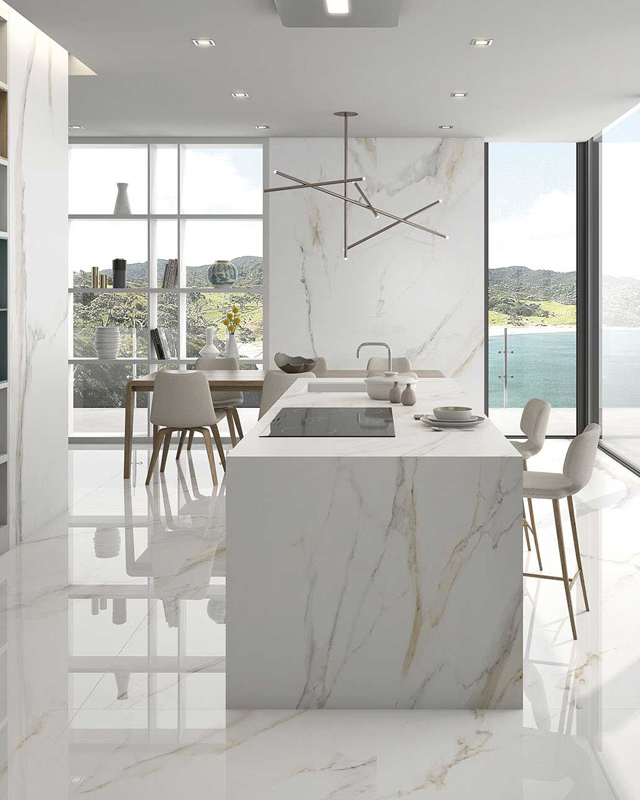
Marble-look GVT and PGVT tiles are the single strongest category for export to Iraq. Natural marble has deep cultural resonance in the region, and polished marble-look porcelain delivers the aesthetic at a fraction of the cost with far lower maintenance requirements. White marble looks (Carrara, Statuario, Calacatta-inspired), beige travertine looks, and grey cement-marble hybrids all sell well.
Rollence Granito's marble-look collection in 600x1200 and 1200x1200 mm polished and lappato finishes has seen strong interest from Iraqi distributors.
Large Plain and Concrete-Look Surfaces
Modern architecture in Baghdad and Erbil increasingly uses large plain surfaces with minimal pattern. Light grey, off-white, warm beige, and greige (grey-beige) tones in large formats give interiors a contemporary look that pairs well with the clean lines of new construction. Concrete-look tiles in matt and satin finishes are used heavily in commercial interiors, offices, and hospitality lobbies.
Wood-Look Tiles
Wood-effect porcelain tiles have grown consistently across Iraqi residential projects over the past several years. The practical argument is strong: real wood warps and deteriorates in Iraq's temperature swings between winter and summer, while wood-look GVT or PGVT tiles maintain their finish indefinitely. Sizes 200x1200 mm and 300x1200 mm in warm oak, walnut, and grey ash looks are the most requested formats.
Geometric and Decorative Accents
Traditional Arabic geometric patterns remain relevant as accent tiles and feature wall applications. These are not the primary floor covering but are used in entry foyers, feature walls in reception areas, and decorative borders. Cement-look geometric tiles in 200x200 mm and 300x300 mm formats serve this niche.
Trending Colour Directions
|
Colour / Tone |
Application |
Segment |
|
Warm white / Cream |
Main living floors, marble-look backgrounds |
All segments |
|
Beige and travertine tones |
Villas, formal rooms, corridors |
Mid to premium |
|
Light grey |
Commercial floors, modern apartments |
Commercial and mid-range |
|
Greige (grey-beige) |
Contemporary villas, open-plan spaces |
Premium residential |
|
Warm oak / Walnut (wood-look) |
Bedrooms, family rooms |
All residential segments |
|
Dark charcoal / Anthracite |
Feature walls, commercial accents |
Commercial and hospitality |
Technical Specifications That Matter for Iraq
The Iraqi climate places specific demands on tile performance. Summer temperatures in Baghdad and Basra regularly exceed 48 degrees Celsius. Buildings experience significant thermal cycling, and tile adhesive and grout selection is critical. Buyers sourcing tiles for Iraq should confirm these technical points:
Key Technical Requirements
- Water absorption: Below 0.5% for porcelain floor tiles (ISO 13006 / EN 14411 Class BIa). Iraqi projects increasingly specify this to distinguish porcelain from lesser grades.
- Breaking strength: Minimum 1300 N for floor tiles in residential; commercial specifications often require 1800 N or higher for heavy-traffic areas.
- Slip resistance: R9 or higher (DIN 51130) for outdoor covered areas, kitchens, and bathrooms. Polished indoor floor tiles typically rated R9.
- Frost resistance: Not a primary requirement for most of Iraq, but relevant for Sulaymaniyah and Kurdish region highlands where winter temperatures drop below freezing.
- Chemical resistance: Important in kitchens and commercial kitchens; confirm Class B or higher rating.
- Abrasion resistance (PEI rating): PEI 3 minimum for residential floors, PEI 4 for commercial and high-traffic areas.
Rollence Granito provides ISO 13006 and EN 14411 test certificates for all export products. Certificate copies are available on request before order placement.
Import and Logistics Considerations for Iraq
Iraq imports tiles primarily through two entry points: Umm Qasr Port near Basra for the southern and central regions, and through land border crossings from Turkey and Iran for the northern Kurdistan region. Understanding routing affects lead times and total landed cost.
Shipping Routes from India
|
Destination |
Recommended Route |
Approx. Transit Time from Mundra |
|
Baghdad, Najaf, Karbala |
Sea via Umm Qasr Port, then road |
18 to 22 days sea + 1 to 3 days inland |
|
Basra |
Sea via Umm Qasr Port |
18 to 20 days sea, closest port |
|
Erbil, Sulaymaniyah |
Sea to Mersin (Turkey) then road, or via Jordan overland |
20 to 28 days depending on route |
|
Mosul |
Via Mersin Turkey then road, or via Jordan/Syria border |
25 to 35 days |
For Kurdistan region buyers, the Mersin-Turkey route is widely used and offers good predictability. Umm Qasr handles the bulk of southern and central Iraq imports. Indian exporters with experience in the Iraqi market will have freight forwarders active on both routes.
Duty and Import Regulations
Iraq currently applies a general import duty of 5-15% on ceramic and porcelain tiles depending on classification. Value-added tax may apply at the point of sale within Iraq. Customs procedures at Umm Qasr require standard trade documents: commercial invoice, packing list, bill of lading, certificate of origin, and conformity documentation.
Some Iraqi buyers request Arabic-language packing descriptions or invoices. Confirm language requirements with your Iraqi importer before shipment to avoid clearance delays.
What Iraqi Buyers Look for in a Tile Supplier
Based on trade patterns and buyer feedback, Iraqi tile importers and distributors consistently prioritise these factors when evaluating new suppliers:
- Consistent quality across repeat orders: Shade variation between orders is a major complaint. Iraqi distributors who stock tiles need shade-consistent reorders.
- Large-format availability: Suppliers without 600x1200 or 800x800 in stock are increasingly at a disadvantage in competitive tender situations.
- Marble-look and stone-look range depth: The wider the design variety in these categories, the stronger the negotiating position in the Iraqi wholesale market.
- Factory-direct pricing: Iraqi importers are experienced buyers. They cross-check prices. Factory-direct suppliers with transparent FOB pricing win against traders with stacked margins.
- Documentation readiness: Certificate of origin, quality certificates, and packing documents available without delays. Slow documentation creates customs problems.
- Sample availability: Ability to send samples quickly for pre-order approval. Iraqi project buyers often finalise specifications through sample approval.
Common Mistakes When Supplying Tiles to Iraq
- Supplying wrong shades on reorders: Shade consistency is non-negotiable for dealers who hold stock. Always mark shade numbers on cartons and lock shade for confirmed orders.
- Overlooking packaging for long transit: Umm Qasr handles large volumes with port congestion. Tiles in weak packaging suffer corner and edge damage. Minimum 5-ply corrugated cartons are non-negotiable.
- Misunderstanding local size preferences: Sending 600x600 when 600x1200 is the market preference wastes container space and creates slow-moving stock for the importer.
- No Arabic documentation: Even for Indian suppliers, having invoice line items and tile descriptions in Arabic or bilingual format speeds up customs and earns goodwill from Iraqi buyers.
- Quoting only CIF when buyer prefers FOB: Experienced Iraqi importers often have established freight agents and prefer FOB pricing so they can manage their own shipping cost.
Why Rollence Granito Supplies the Iraq Market
Rollence Granito manufactures GVT, PGVT, and large-format porcelain slabs in Morbi, Gujarat with export experience across Middle East markets including Iraq. The product range includes marble-look polished tiles, concrete and stone-look matt surfaces, wood-look formats, and plain large-format collections in sizes from 600x600 mm to 1200x2400 mm.
Export packaging meets sea freight requirements for the Umm Qasr and Mersin routes. Quality certificates for ISO 13006 compliance are available for all collections. Iraqi importers and distributors can request the current catalogue, shade samples, and FOB pricing through rollence.in.
Frequently Asked Questions
Which tile size is most popular in Iraqi homes?
The 600x1200 mm format is currently the most imported size for main living areas in Iraq. The 800x800 mm format remains strong for mid-range residential and commercial floors. Smaller 600x600 mm tiles are used in service areas and budget housing projects.
Do Iraqi buyers prefer polished or matt tiles?
Polished and lappato finishes dominate formal areas including sitting rooms, reception halls, and corridors in Iraqi homes. Matt tiles are used in commercial spaces, kitchens, and outdoor covered areas. Both finishes are imported in significant volumes.
What designs sell best in the Iraqi tile market?
Marble-look porcelain tiles are the top-selling design category. White, beige, and grey marble-inspired prints in polished or lappato finish consistently rank highest in demand. Wood-look and plain large-format concrete-look tiles follow as the second and third strongest categories.
How are tiles shipped from India to Iraq?
Most shipments route through Mundra or Nhava Sheva port in India to Umm Qasr Port near Basra for southern and central Iraq. Northern Iraq and the Kurdistan region receive shipments via Mersin Port in Turkey followed by road transport. Sea transit from Mundra to Umm Qasr is 18 to 22 days.
What is the import duty on tiles in Iraq?
Iraq applies import duty in the range of 5 to 15% on ceramic and porcelain tiles. Rates depend on tile classification and HS sub-code. Confirm current applicable rates with a licensed customs broker in Iraq before finalising landed cost calculations.
Does Rollence Granito export directly to Iraq?
Yes. Rollence Granito exports to Iraq through established freight routes via Umm Qasr and Mersin. Iraqi importers can contact Rollence Granito directly through rollence.in for product catalogue, pricing, and sample requests.
What quality certifications are available for Iraqi project specifications?
Rollence Granito provides ISO 13006 and EN 14411 test certificates for export products. Certificate of Origin is issued through EEPC or local Chamber of Commerce. These documents cover the standard requirements for Iraqi project tenders and customs clearance.
Connect with Rollence Granito for Iraq Tile Supply
Rollence Granito exports porcelain floor and wall tiles to Iraq and 40+ countries from Morbi, Gujarat. If you are an Iraqi importer, distributor, or project buyer looking for factory-direct pricing, documented quality, and a wide marble-look and large-format catalogue, reach out through rollence.in.
The current product range, shade samples, and FOB pricing are available on request. Shipments can be arranged for both FCL and LCL volumes to Umm Qasr and Mersin.

