



How to Check Export Quality in Porcelain Tiles Before Buying
Every tile looks good in a catalogue photo. The difference between a factory that ships consistent, export-grade porcelain and one that ships mixed-quality production shows up after the container arrives, not before. By then, the leverage is gone.
Quality disputes are the most common problem in tile imports. Shade variation between orders, calibration differences within a single lot, surface defects that show up after grouting, and water absorption values that do not match the specification sheet are all avoidable if you know what to check before confirming a purchase.
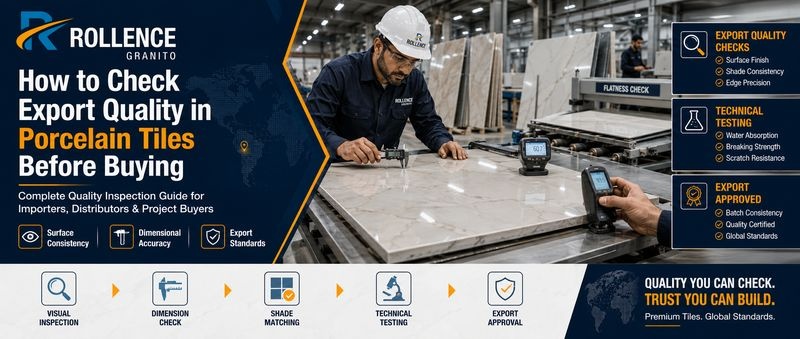
This guide walks through every quality check that matters for export-grade porcelain tiles: the tests, the standards, the tolerances, and what each parameter tells you about the tile you are about to buy. Rollence Granito applies these checks across its production lines in Morbi, Gujarat before any export shipment leaves the factory.
Why Quality Checks Matter More for Imports Than Local Purchases
When you buy tiles locally, a quality problem is correctable. You can return to the supplier, inspect the next lot, or refuse delivery. With an international shipment, by the time the container clears customs and reaches your warehouse, your options narrow significantly.
Freight cost, customs duty, and unloading charges are already sunk. Returning a shipment costs more than the tiles themselves in most cases. Filing a quality claim requires photographic evidence, inspection reports, and a supplier willing to cooperate. Most buyers settle for a partial credit rather than a replacement shipment.
The only reliable protection is front-loading the quality check. Request documentation before production, inspect samples before approving, and arrange pre-shipment inspection before the container is sealed. Each of these steps costs less than 0.5% of a typical order value and prevents losses that can reach 20 to 30% of the shipment.
The Key Quality Parameters for Export Porcelain Tiles
ISO 13006 is the international standard governing ceramic and porcelain tile quality. The EN 14411 standard used in Europe maps directly to ISO 13006. Together these define the tolerances and test methods that export-grade porcelain tiles should meet. Understanding the parameters gives you a framework for evaluating any supplier's quality claims.
1. Water Absorption
Water absorption is the most fundamental measure separating porcelain from ceramic tiles. True porcelain has water absorption below 0.5% by weight. This low absorption comes from the high firing temperature (1200 to 1230 degrees Celsius) and the density of the vitrified body.
|
Tile Type |
Water Absorption |
ISO 13006 Class |
|
Porcelain (fully vitrified) |
Below 0.5% |
BIa |
|
Vitrified (semi-porous) |
0.5% to 3% |
BIb |
|
Single fired floor ceramic |
3% to 6% |
BIIa |
|
Wall ceramic |
6% to 10% |
BIIb |
|
Traditional ceramic |
Above 10% |
BIII |
Ask for a third-party lab certificate showing water absorption test results conducted per ISO 10545-3. A supplier who cannot provide this document for export-grade porcelain is a red flag. The test takes 24 hours and costs under USD 30 per sample at any NABL-accredited lab in India.
2. Breaking Strength and Modulus of Rupture
Breaking strength tells you how much force a tile can withstand before it cracks. For floor tiles under foot traffic and point loads, this matters practically. Modulus of rupture measures the same property normalised for thickness, making it a more useful comparison across different tile sizes.
|
Application |
Minimum Breaking Strength |
Minimum Modulus of Rupture |
|
Residential floor |
1300 N |
35 N/sq mm |
|
Commercial floor (moderate traffic) |
1800 N |
35 N/sq mm |
|
Heavy commercial / industrial |
2000 N+ |
35 N/sq mm |
|
Wall tiles (non-load bearing) |
600 N minimum |
No specific minimum |
Test method is ISO 10545-4. Values below the residential threshold in a tile marketed as a floor tile are a specification misrepresentation. For large-format tiles (above 900 mm in any dimension), breaking strength above 1500 N is advisable due to the increased span between support points during laying.
3. Dimensional Accuracy and Calibration
Calibration refers to how consistent tile dimensions are within a production lot. Tiles from the same batch should be within tight dimensional tolerances so that when laid with uniform joint spacing, the grout lines appear even across the floor.
|
Parameter |
ISO 13006 Tolerance (BIa Class) |
What It Means in Practice |
|
Length and width variation |
Within plus or minus 0.6% of nominal size |
For a 600 mm tile, variation up to 3.6 mm is permissible |
|
Thickness variation |
Within plus or minus 5% of nominal thickness |
For a 10 mm tile, variation up to 0.5 mm |
|
Straightness of sides |
Within plus or minus 0.5% of nominal size |
Bow on the side edge not exceeding 3 mm for 600 mm tile |
|
Rectangularity |
Within plus or minus 0.6% of diagonal |
Ensures corners are square, not rhomboidal |
|
Surface flatness (centre bow) |
Within plus or minus 0.5% of nominal diagonal |
Tile face should not cup or arch more than this |
When evaluating samples, lay four tiles together on a flat surface with uniform 2 mm spacers and check for lippage: height difference at joints. Visible lippage above 1 mm across a flat surface indicates calibration issues. On large-format tiles above 1000 mm, lippage tolerance tightens further because longer spans amplify small dimensional differences.
4. Surface Quality
ISO 13006 defines surface quality by the percentage of tiles in a lot that are free from visible defects when viewed from 1 metre under normal lighting conditions. The standard requires at least 95% of tiles in a lot to be defect-free.
Common surface defects to check in samples:
- Pinholes: Small craters in the glaze surface, visible on polished finishes under raking light
- Crawling: Areas where glaze has receded, leaving bare or rough patches
- Colour spots: Off-colour dots or patches inconsistent with the design intent
- Print registration errors: Digital print that is misaligned relative to the tile edges
- Edge chips: Small breaks at tile corners or edges from handling during production
- Shade patches: Uneven colour distribution within a single tile face
The most practical check is to unwrap 10 to 15 tiles from different carton positions in a sample lot and inspect under natural or bright diffuse light at a 45-degree viewing angle. Raking light from a torch will expose pinholes and glaze issues that flat overhead lighting misses.
5. Shade and Tone Consistency
Shade consistency is separate from surface quality. Two tiles can both be defect-free but be different shades of the same colour due to kiln temperature variation or ink batch differences. For large orders, shade variation is a major practical problem because it shows up as visible colour change across the installed floor.
Indian manufacturers assign shade numbers (sometimes called batch numbers or lot numbers) to production runs. All tiles from the same shade number are produced in one continuous kiln cycle and should be colour-consistent with each other. Tiles from different shade numbers may appear similar in a sample but differ visibly when installed side by side.
- Always ask the supplier to mark shade numbers on every carton
- Confirm that your full order quantity is available from a single shade number before proceeding
- For large orders delivered in multiple shipments, lock the shade number in your Purchase Order and require it to match across all deliveries
- If mixing shade numbers is unavoidable, install from multiple cartons simultaneously to blend the variation across the floor
6. Slip Resistance
Slip resistance is rated using the DIN 51130 R-value system (R9 to R13) or the DCOF (Dynamic Coefficient of Friction) method used in the United States. The R-value indicates the minimum slope angle at which a person in safety boots begins to slip on the surface.
|
R Rating |
Suitable For |
Typical Finish |
|
R9 |
Normal residential interiors, dry floors |
Polished, lappato, smooth matt |
|
R10 |
Kitchens, bathrooms, covered outdoor areas |
Matt, sugar finish, light texture |
|
R11 |
Commercial kitchens, wet outdoor areas |
Structured, medium texture |
|
R12 |
Industrial floors, ramps with water |
Heavy texture, anti-slip |
|
R13 |
Extreme wet conditions, industrial ramps |
Very coarse texture |
Polished PGVT floor tiles typically carry an R9 rating. This is acceptable for dry residential interiors but should not be used in kitchens, bathrooms, or any area that gets wet. Buyers who specify PGVT polished for bathroom floors are making a technical error that creates safety risk.
7. Chemical Resistance
Floor and wall tiles in kitchens, commercial food service areas, and bathrooms are exposed to cleaning chemicals, acids, and alkalis. ISO 10545-13 tests chemical resistance across five classes (AA to D) for household chemicals and three classes (A to C) for pool salts and low-concentration acids.
For standard residential use, Class B household chemical resistance is the minimum acceptable. Tiles used around swimming pools or in commercial kitchen floors need Class A resistance. Ask for the chemical resistance class in the product specification sheet.
8. Abrasion Resistance (PEI Rating)
The PEI (Porcelain Enamel Institute) rating classifies a glazed tile's resistance to visible surface wear from foot traffic. It applies to glazed tiles, not to full-body or polished tiles where the wear layer is the tile body itself.
|
PEI Class |
Traffic Level |
Suitable Application |
|
PEI 1 |
Bare feet only |
Bathroom walls, areas with no outdoor shoe traffic |
|
PEI 2 |
Light residential |
Bathrooms and bedrooms with soft footwear |
|
PEI 3 |
Moderate residential |
All residential interiors except heavy-use areas |
|
PEI 4 |
Heavy residential, moderate commercial |
Kitchens, hallways, retail |
|
PEI 5 |
Heavy commercial and industrial |
Shopping centres, airports, high-traffic public areas |
How to Evaluate a Tile Supplier's Quality Claims
A supplier's quality claim is only as good as the documents behind it. Here is what to ask for and how to read what you receive.
Documents to Request Before Placing an Order
|
Document |
What It Confirms |
Who Issues It |
|
ISO 13006 / EN 14411 Test Certificate |
Water absorption, breaking strength, dimensional tolerance, surface quality all meet standard |
NABL lab or equivalent third-party lab |
|
Factory ISO 9001 Certificate |
Quality management system is in place and audited |
Third-party certification body (BIS, Bureau Veritas, etc.) |
|
Shade/Batch Certificate |
Tiles in the lot belong to a specific production shade number |
Manufacturer |
|
PEI Rating Certificate |
Abrasion resistance class for glazed tile surfaces |
Third-party lab |
|
Slip Resistance Certificate |
R-value per DIN 51130 or DCOF per ANSI A326.3 |
Third-party lab |
|
Chemical Resistance Certificate |
Class per ISO 10545-13 |
Third-party lab |
Not every order requires all six documents. Water absorption, breaking strength, and dimensional tolerance are non-negotiable for any export-grade porcelain claim. Slip resistance and PEI become important when end-use application requires them. Chemical resistance matters for food service, pool surrounds, and industrial applications.
Reading a Test Certificate
Test certificates list test results against standard limits. Check three things:
- Date of test: Certificates older than two years may not reflect current production quality. Ask for a recent certificate.
- Sample description: The tile size and type described in the certificate should match what you are ordering. A certificate for 600x600 GVT does not cover 600x1200 PGVT from the same factory.
- Lab accreditation: The issuing lab should carry NABL accreditation (India) or an equivalent national accreditation body. Certificates from unaccredited in-house labs carry no independent verification value.
How to Inspect Tile Samples Before Approving an Order
Physical sample inspection is the most practical quality check available to a buyer before committing to a full order. Here is a systematic approach.
Sample Inspection Checklist
|
Check |
Method |
Pass Condition |
|
Calibration |
Measure 5 tiles with vernier calipers; compare length, width, thickness |
All within ISO tolerance of nominal size |
|
Flatness |
Place tile on flat surface; press corners; check bow with feeler gauge |
No corner lifts; centre bow within 0.5% of diagonal |
|
Lippage |
Lay 4 tiles on flat surface with 2 mm spacers; check joint height difference |
No visible step at joints; below 1 mm |
|
Surface under raking light |
Hold torch at 15-degree angle across tile face in dark room |
No pinholes, crawling, or glaze defects visible |
|
Shade consistency |
View 10 tiles together under daylight |
No visible colour shift between tiles from same shade number |
|
Sound test (ring test) |
Suspend tile on finger and tap centre with knuckle |
Clear ring tone; dull thud suggests internal crack |
|
Water absorption (field test) |
Drop water on back face; observe absorption over 60 seconds |
Water sits as bead; no absorption. Porous tile absorbs quickly. |
|
Edge quality |
Run fingertip along all four edges |
No chips, sharp breaks, or rough glazing at edges |
|
Print alignment |
Compare print pattern to edge alignment on 5 tiles |
Pattern consistent, no visible misregistration |
The sound test (ring test) is a quick and practical field check. A tile with an internal crack or poor firing produces a flat, dull sound when tapped. A well-fired, dense porcelain tile rings clearly. This test does not replace lab certification but is useful for spot-checking at arrival.
Pre-Shipment Inspection: When and How
A pre-shipment inspection is a third-party check conducted at the factory after goods are packed and ready to load. The inspector verifies that what is being shipped matches what was ordered.
When Pre-Shipment Inspection Makes Sense
- Orders above USD 8,000 to 10,000 in value
- First order with a new supplier
- Orders for large project requirements where replacement lead time is long
- Shipments to markets with high customs scrutiny or strict conformity requirements
What a Pre-Shipment Inspection Covers
- Quantity verification: Carton count, tile count per carton, and total square metres against packing list
- Shade and batch number verification: Confirms shade numbers on cartons match those specified in the order
- Visual surface inspection: Sample of tiles opened from different carton positions checked against surface quality standard
- Dimensional check: Calibre and flatness verified on a statistical sample per AQL (Acceptable Quality Level) protocol
- Packaging integrity: Carton strength, interleaving material, pallet wrapping checked for sea freight adequacy
- Marking and labelling: Carton markings, country of origin labels, and tile size/shade markings checked against order
Major inspection agencies active in Morbi include SGS, Bureau Veritas, Intertek, and TUV Rheinland. Cost for a standard tile container inspection is approximately USD 250 to 400. The inspection report is issued within 24 to 48 hours and can be used for customs, insurance, and dispute resolution purposes.
AQL Sampling: What the Numbers Mean
AQL (Acceptable Quality Level) sets the maximum defect percentage acceptable in a lot. Most tile inspections use AQL 2.5 for major defects and AQL 4.0 for minor defects. This means the inspection accepts the lot if the defect count in the sample falls below a defined threshold for the lot size.
A buyer who specifies AQL 1.0 gets a stricter pass threshold. This matters for premium tile orders where surface quality is critical. Confirm the AQL level with your inspection agency when booking the inspection.
Quality Checks Specific to Tile Categories
GVT and PGVT Tiles
- Confirm glaze layer thickness: GVT tiles carry 0.3 to 0.5 mm digital glaze; PGVT goes through a post-kiln polishing process. Ask the factory for the glazing thickness specification.
- Check polishing uniformity on PGVT: Uneven polishing shows as dull patches on the tile face under raking light.
- Verify slip resistance on PGVT polished: Polished surfaces reduce R-value. Do not specify PGVT polished for wet areas.
Large Format Tiles (Above 900 mm)
- Flatness tolerance is tighter for large formats. A 1 mm bow that is acceptable on a 600x600 tile becomes a serious lippage issue on a 1200x1200 tile.
- Check warping on the diagonal, not just the sides. Diagonal bow on large formats is a common production issue.
- Confirm loading and handling protocol: Large format tiles need edge-on loading in containers. Flat stacking causes warping under load.
Porcelain Slabs (800x1600 and Above)
- Check for internal micro-cracks using transmitted light: Hold slab up to bright light or use a UV torch. Micro-cracks appear as dark lines.
- Verify thickness consistency across the full slab face. Variation above 0.5 mm across a 1200x2400 slab causes problems in countertop and cladding applications.
- Confirm edge finish: Cut edges on slabs should be smooth with no micro-chips from the cutting process.
Digital Wall Tiles
- Print consistency matters more than dimensional tolerance for wall tiles. Check that the pattern aligns correctly across four tiles placed together.
- Glaze adhesion: Wall tiles carry thicker glaze layers. Check for crawling at the tile edges where glaze sometimes recedes during firing.
- Weight and thickness: Confirm tiles are standard 8 to 10 mm for wall use. Tiles below 7 mm need specific adhesive and are more prone to breakage during installation.
Common Quality Shortcuts That Cost Buyers Money
- Accepting a spec sheet instead of a test certificate: Spec sheets are self-declared. Test certificates carry third-party verification. They are not the same document.
- Checking only the first sample and assuming consistency: Production quality varies between runs. Check samples from a recent batch, not a sample kept in the showroom for two years.
- Ignoring shade numbers: The single biggest source of tile import disputes is shade variation between the first and second shipment. Lock shade numbers before placing any reorder.
- Skipping pre-shipment inspection to save USD 300: A single container of off-spec tiles represents USD 8,000 to 20,000 in goods plus freight and duty. The math does not support skipping inspection.
- Not specifying AQL level: Leaving inspection criteria vague lets the factory pass goods that a buyer would reject. Always specify AQL 2.5 minimum for major defects.
- Trusting verbal quality assurances: Written specifications in the Purchase Order are the only enforceable quality standard. What a sales manager says on a call carries no weight in a dispute.
How Rollence Granito Handles Export Quality
Rollence Granito applies quality checks at three stages of production: raw material testing before firing, in-process checks at kiln exit, and final inspection before packing. The factory carries ISO 13006 compliance certification across its GVT, PGVT, and large-format slab product lines.
Test certificates from NABL-accredited labs are maintained for all export collections and are available to buyers before order confirmation. Shade numbers are printed on every carton. Pre-shipment inspection by buyer-nominated agencies can be arranged at any point before container sealing.
Buyers placing first orders with Rollence Granito can request a sample dispatch within 2 to 3 business days and receive the full quality documentation set alongside the samples. Enquiries can be sent through rollence.in.
Frequently Asked Questions
What is the water absorption limit for export-grade porcelain tiles?
Export-grade porcelain tiles should have water absorption below 0.5% by weight, per ISO 13006 Class BIa. This distinguishes true porcelain from semi-porous vitrified and ceramic tiles. Always ask for a third-party lab certificate showing the ISO 10545-3 test result.
What does calibration mean in tiles?
Calibration refers to dimensional consistency within a tile lot. All tiles in a batch should be within the ISO 13006 tolerance of their nominal size (plus or minus 0.6% for length and width in Class BIa). Poor calibration causes visible lippage (height differences at joints) after laying.
What is the AQL standard for tile pre-shipment inspection?
AQL 2.5 is the standard used for major defects in most tile pre-shipment inspections. This means the lot is accepted if the defect count in the inspection sample falls below the AQL 2.5 threshold table for the lot size. Buyers can specify stricter AQL 1.0 for premium tile orders.
How do I check tile quality without a lab?
Several field checks work without laboratory equipment: the sound test (tap the tile and listen for a clear ring versus a dull thud), the water drop test on the back face (porcelain resists absorption; water beads up), visual inspection under raking torchlight for pinholes and surface defects, and laying tiles on a flat surface to check calibration and lippage. These are screening checks, not replacements for certified test reports.
What is the difference between ISO 13006 and EN 14411?
ISO 13006 is the international standard for ceramic tiles covering all test methods and performance classes. EN 14411 is the European standard that adopts ISO 13006 with some European-specific additions. For practical purposes, a tile meeting ISO 13006 BIa requirements also meets EN 14411 BIa. Buyers in the EU market should confirm EN 14411 labelling with their supplier.
Should I always request pre-shipment inspection for tile orders?
For first-time orders with a new supplier or orders above USD 10,000, pre-shipment inspection is strongly advisable. The cost of approximately USD 250 to 400 is small relative to the risk of receiving a full container of off-spec goods. For established suppliers with a consistent quality record, inspection frequency can be reduced to spot checks.
What documents should I receive from an Indian tile exporter for quality verification?
At minimum: ISO 13006 or EN 14411 test certificate from a NABL-accredited lab, covering water absorption, breaking strength, and dimensional tolerance. Additionally: shade/batch certificate, factory ISO 9001 certificate, and slip resistance or PEI certificate if the application requires them.
Source Export-Quality Porcelain Tiles from Rollence Granito
Rollence Granito manufactures GVT, PGVT, and large-format porcelain slabs in Morbi, Gujarat and exports to 40+ countries. All export collections carry ISO 13006 certification from NABL-accredited labs. Quality documentation, shade certificates, and pre-shipment inspection support are available for every order.
Buyers looking to verify quality before placing an order can request a sample dispatch and the full documentation set through rollence.in.

