



What Makes Indian Vitrified Tiles Competitive in Global Markets
India's ceramic tile market was valued at 10.45 billion US dollars in 2025 and is on track to cross 11.3 billion dollars in 2026, according to Mordor Intelligence. Morbi, Gujarat, produces close to 90 percent of that output across more than 1,800 manufacturing units, per IBEF's January 2026 industry review. Indian porcelain tiles now sell at 15 to 20 dollars per square metre against 30 to 35 dollars for Italian tiles and 25 to 30 dollars for Spanish product, a gap wide enough to redirect global sourcing decisions.
Vitrified tiles are fired at high temperature until the clay body reaches near-zero porosity, which is what gives them strength, low water absorption and resistance to staining. That manufacturing intensity used to be Europe's advantage. Indian producers have closed that gap over the past decade through scale, machinery investment and export-focused certification, which is why buyers sourcing for hotels, retail chains and residential towers now shortlist Indian porcelain tiles manufacturers alongside European names rather than as a budget fallback.
Manufacturing Scale Keeps Landed Cost Low
Morbi's cluster runs over 1,200 factories and more than 12,000 production lines, exporting to over 150 countries as of 2026, according to Construction Estimator India. That density means glaze suppliers, packaging units, mould makers and freight forwarders all sit within the same industrial belt, cutting the transport and coordination cost that adds up elsewhere.
Rollence Granito operates from this exact ecosystem in Wanakaner, Morbi, which keeps raw material sourcing, kiln capacity and finishing lines under tight logistical control. A buyer placing a container order does not pay for the fragmentation that spread-out manufacturing hubs carry in other countries. That density is a direct, measurable input into the final FOB price.
Technology Investment Now Matches European Lines
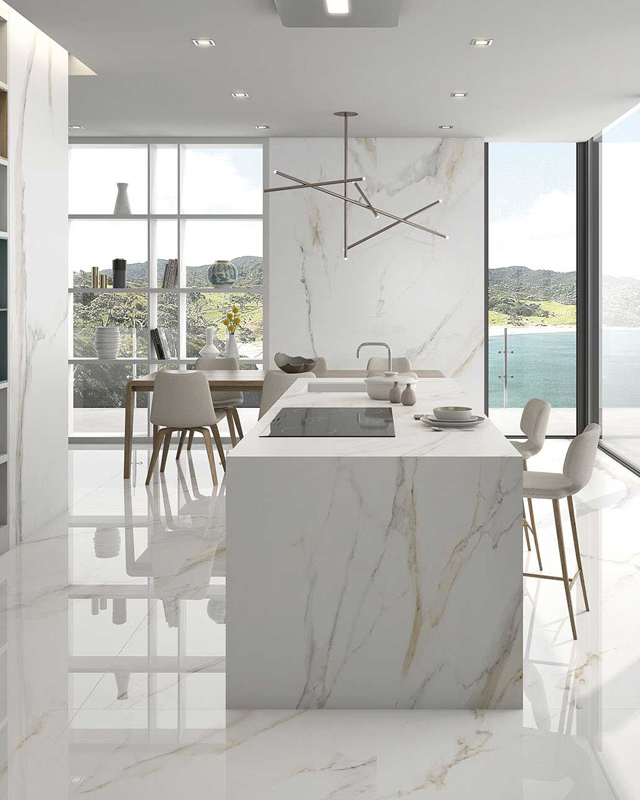
Morbi factories run Sacmi, System Ceramics and Fintech machinery, the same equipment used in Italian and Spanish plants, enabling digital inkjet printing, rectified edges and nanopolish finishing, per Construction Estimator India's 2026 review. This closed the visual gap that once separated Indian tiles from European originals, particularly on marble-look and stone-look porcelain slabs.
Full-body and glazed vitrified tiles made on this equipment are fired to under 0.5 percent water absorption, the same threshold that defines porcelain tile under international standards, which is why Indian GVT and PGVT output is marketed internationally as porcelain. Buyers get the surface realism of a European digital print on a body engineered for Indian export volumes.
Price and Trade Terms Favour Indian Sourcing
Under the Comprehensive Economic Partnership Agreement, tile exports from India to the UAE and the wider GCC region carry zero import duty, a direct cost advantage over competing origins still facing standard tariff schedules, per Construction Estimator India. Combined with a sub-4-dollar-per-square-metre average export price recorded by IndexBox in 2024, Indian tiles hold a landed-cost position few producing nations can match on comparable specification.
India's tile export revenue grew at a compound annual rate of approximately 21.7 percent, with volumes rising from 55 million square metres in 2013 to 589.5 million square metres in 2023, overtaking both Italy and Spain in export volume, according to TreeTile's 2026 country data. That growth was not achieved through discounting alone. It reflects buyers repeat-ordering because landed cost and product consistency both hold up.
Design Range Covers Every Project Brief
Morbi manufacturers now offer over 1,000 distinct design variations spanning glossy, matte, linen, carving, terrazzo and wood-look finishes, per TreeTile's 2026 export report. Large-format slabs in sizes like 800x1600 mm and 1200x1800 mm have moved from niche to mainstream demand, driven by architects specifying fewer grout lines for hospitality and retail interiors.
Rollence Granito's catalogue runs into hundreds of variants across size, texture and colour, built specifically so a single container order can mix formats without sacrificing consistency across batches. For an importer managing multiple project sites, that range removes the need to split orders across several factories.
Certification Gives Buyers a Reason to Trust the Paperwork
ISO 9001:2015 for quality management and ISO 14001:2015 for environmental management are now standard expectations from serious international buyers, not nice-to-have extras. Manufacturers holding both, alongside BIS compliance for slip-resistance ratings such as R10 to R13, give importers a documented basis for customs clearance and project specification sign-off rather than a verbal assurance.
This paperwork matters more than it sounds. Buyers in the EU need CE marking, US buyers need accurate HS coding after the 2025 tariff changes, and GCC buyers need documentation that survives anti-dumping scrutiny. A manufacturer that treats certification as core infrastructure, not an afterthought, is the one that keeps shipments moving without customs delays.
Porcelain Tile Export Comparison: India vs Italy vs Spain vs China
|
Origin |
Average Export Price/sqm |
2023 Export Volume |
Typical Lead Time |
|
India |
USD 15 to 20 (premium) / USD 4.1 (average FOB) |
589.5 million sqm |
15 to 45 days to most ports |
|
Italy |
USD 30 to 35 |
Lower volume, higher value mix |
20 to 40 days to most ports |
|
Spain |
USD 25 to 30 |
Moderate volume |
20 to 40 days to most ports |
|
China |
Competitive on volume, variable on design IP |
High volume |
20 to 35 days to most ports |
Where the Cost Gap Goes From Here
The gap between Indian and European tile pricing is not closing through European producers cutting cost. It is closing through Indian manufacturers moving up the design and certification ladder while keeping the scale advantage intact. Buyers who priced Indian tiles as a budget option five years ago are now specifying them for premium hospitality and retail projects.
For importers evaluating porcelain tiles manufacturers for a 2026 order cycle, the sourcing decision increasingly comes down to which factory backs its price with certification, consistent large-format production and a design catalogue that covers the full project brief in one container.
Frequently Asked Questions: What Makes Indian Vitrified Tiles Competitive in Global Markets
What makes Indian vitrified tiles cheaper than Italian tiles?
Indian vitrified tiles cost less mainly due to Morbi's cluster density, lower labour and gas-linked energy costs, and CEPA duty benefits into GCC markets. Italian tiles carry higher design royalties and smaller-batch production, which raises their per-square-metre price to 30 to 35 dollars.
Is GVT the same as porcelain tile?
GVT and PGVT tiles are fired to the same sub-0.5 percent water absorption threshold used internationally to define porcelain tile, which is why Indian manufacturers market them as porcelain. The distinction is largely regional terminology rather than a difference in technical performance.
Which country produces the most vitrified tiles for export?
India is now the world's largest exporter of vitrified and porcelain tiles by volume, having overtaken Italy and Spain, with Morbi, Gujarat, producing close to 90 percent of national output across over 1,800 factories.
Do Indian tile exports face anti-dumping duties?
Some markets, including Saudi Arabia, Qatar and Mexico, have imposed or investigated anti-dumping measures on Indian ceramic tiles. The US Commerce Department's April 2025 review, however, found no dumping evidence and set countervailing duties at just 3.06 to 3.45 percent.
What tile sizes are most in demand for export in 2026?
Large-format porcelain slabs in 800x1600 mm and 1200x1800 mm are seeing the fastest growth, driven by hospitality and retail projects that want fewer visible grout lines, alongside steady demand for 600x1200 mm and 800x800 mm formats.
How do I verify a genuine Indian porcelain tile exporter?
Check for ISO 9001:2015 and ISO 14001:2015 certification, ask for BIS test reports on slip resistance and water absorption, request container-loading photos or video, and confirm the factory address against Morbi or Wanakaner industrial zone records.

