



How Are Vitrified Tiles Manufactured? Step-by-Step Process
Vitrified tiles have become one of the most preferred flooring materials in modern construction. Their strength, low water absorption, and clean finish make them suitable for both residential and commercial spaces.
Many buyers and professionals search for the vitrified tiles manufacturing process to understand why these tiles perform better than traditional options. This guide explains how vitrified tiles are made, from raw material selection to final quality checks, in a clear, practical way.
For projects that require premium finishes and precise sizing, working with a trusted 800x1600 porcelain tiles supplier in Iraq provides consistent quality, durability, and timely availability for large-scale and custom developments.
What Is the Vitrified Tiles Manufacturing Process?
The vitrified tiles manufacturing process refers to the industrial method of producing dense, low-porosity tiles by firing carefully selected raw materials at very high temperatures.
Unlike ceramic tiles, vitrified tiles undergo a vitrification reaction in which materials partially melt and fuse. This creates a tile that is harder, less porous, and more durable.
Raw Materials Used in Vitrified Tiles Manufacturing
Primary Raw Materials
The quality of vitrified tiles begins with the vitrified tiles' raw materials used in production:
- Clay: Provides plasticity and shape
- Silica: Adds strength and hardness
- Feldspar: Acts as a flux during firing
- Quartz: Improves density and wear resistance
Why Raw Material Quality Matters
The vitrified tiles' raw material composition directly affects:
- Water absorption levels
- Mechanical strength
- Surface finish consistency
Poor-quality raw materials can lead to warping, cracks, and uneven finishes.
Vitrified Tiles Manufacturing Process Step by Step
Step 1: Raw Material Batching and Mixing
Raw materials are accurately weighed and mixed based on the tile formulation. This ensures consistency across every production batch.
Step 2: Grinding and Milling
The mixture is ground in ball mills to create a fine slurry. Uniform particle size is critical for tile density and surface quality.
Step 3: Spray Drying
The slurry is passed through a spray dryer, where it is converted into fine granules. These granules are ideal for pressing tiles with uniform density.
Step 4: Tile Pressing and Shaping
High-pressure hydraulic presses shape the tiles. This step controls thickness, size, and overall strength.
Step 5: Drying Process
Pressed tiles are dried to remove residual moisture. Proper drying prevents cracks and bending during firing.
Step 6: Glazing or Surface Treatment
Depending on the tile type, surfaces may be glazed or digitally printed. This stage defines the tile's design and texture.
Step 7: Firing in the Kiln
Tiles are fired at temperatures typically ranging between 1200°C and 1250°C. This vitrification temperature during firing results in a dense, low-porosity structure.
Step 8: Polishing Process
In the vitrified tiles polishing process, tiles are polished to achieve the desired gloss or matte finish. Surface flatness and shine are refined here.
Step 9: Sorting and Quality Control
The vitrified tiles quality control process includes:
- Dimensional accuracy checks
- Shade variation control
- Water absorption testing
- Surface defect inspection
Only tiles meeting quality standards move to packaging.
Vitrified Tiles Manufacturing Technology Used Today
Modern vitrified tiles manufacturing technology includes:
- Fully automated production lines
- Digital inkjet printing
- Energy-efficient roller kilns
These technologies improve consistency and reduce defects.
Vitrified Tiles Manufacturing Plant Setup Overview
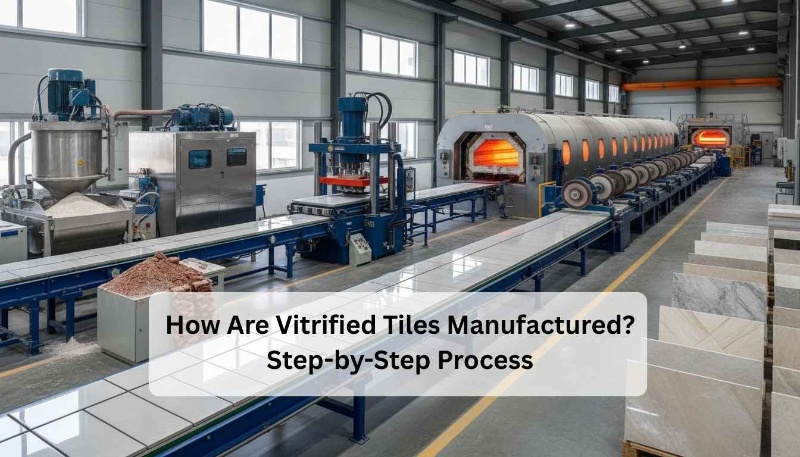
A typical vitrified tiles manufacturing plant includes:
- Raw material storage
- Milling and spray drying units
- Pressing section
- Kilns and polishing lines
- Quality control and packing area
A well-planned vitrified tiles production line ensures high output with minimal waste.
Manufacturing Cost Factors in Vitrified Tiles
The vitrified tiles manufacturing cost depends on:
- Raw material sourcing
- Energy consumption during firing
- Level of automation
- Quality control processes
Higher investment in technology usually results in better tile performance.
Difference Between Vitrified and Ceramic Tile Manufacturing
The difference between vitrified and ceramic tile manufacturing lies mainly in:
- Firing temperature
- Raw material refinement
- Final tile density
For a more precise material comparison, refer to the detailed ceramic vs. porcelain vs. vitrified tiles comparison, which explains how manufacturing processes impact real-world performance.
Why Manufacturing Quality Matters in Tile Performance
Manufacturing quality affects:
- Tile lifespan
- Resistance to moisture
- Surface finish durability
If you want to understand how these tiles perform after installation, explore the complete guide to vitrified and porcelain tiles, which covers uses and benefits in detail.
Common Misconceptions About Vitrified Tile Manufacturing
- All vitrified tiles are manufactured the same way
- High gloss automatically means better quality
- Manufacturing location does not affect performance
In reality, process control and raw material quality matter more than appearance.
Final Thoughts
Understanding the vitrified tiles manufacturing process helps buyers and professionals appreciate why these tiles offer superior durability and performance.
When tiles are manufactured with the right raw materials, controlled firing, and strict quality checks, the result is flooring that lasts for years with minimal maintenance.
Large-format tiles are increasingly used in modern designs, and choosing a dependable 1200x1200 porcelain tile supplier in Iraq helps ensure a uniform finish, strength, and a reliable supply for demanding projects.
Choosing tiles is not just about design. It starts at the manufacturing stage, where brands like Rollence Granito focus on quality, precision, and long-term performance.
FAQs on Vitrified Tiles Manufacturing Process
What temperature are vitrified tiles fired at?
They are typically fired between 1200°C and 1250°C.
How long does vitrified tile production take?
From raw material mixing to final packing, the process can take several hours, depending on the plant's setup.
Are vitrified tiles fully waterproof?
They have very low water absorption but are not entirely waterproof.

