


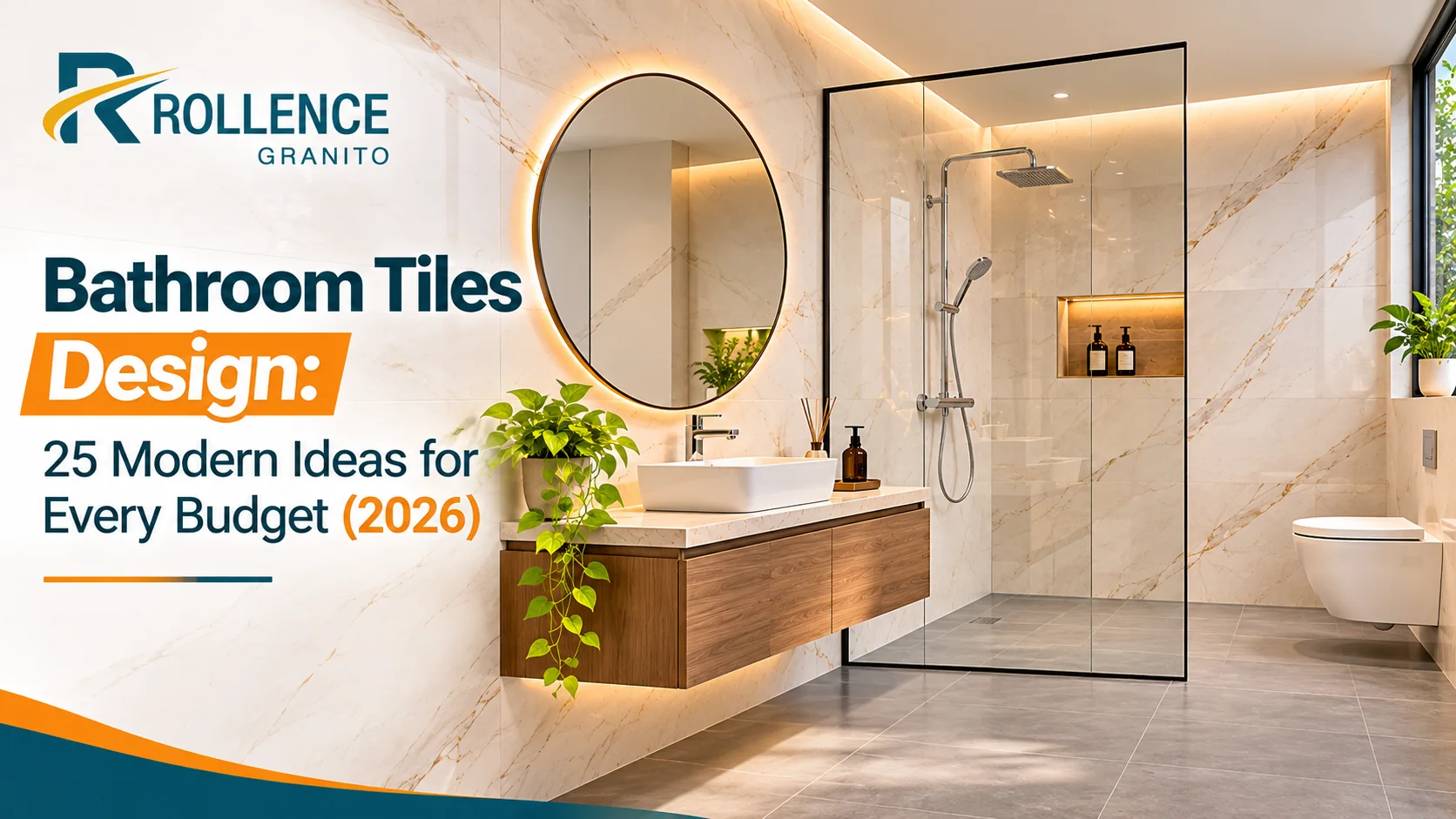
The best bathroom tiles design keeps the floor matte and anti-skid, and saves glossy or polished tiles for the walls. Everything else (colour, size, pattern) is a budget decision, and this guide sorts 25 ideas into three budget bands so you can start from the number you have.
If you want the finish logic behind these ideas, our note on bathroom tile design trends with glossy and natural finishes explains why the two finishes behave so differently in a wet room.
| Quick answer: For a standard Indian bathroom, use a matte 600x600 GVT or a 300x300 ceramic tile on the floor, and a glossy or matte wall tile up to ceiling height. Expect Rs 25 to Rs 75 per sq ft for the basic band, Rs 80 to Rs 140 for large-format 800x1600 walls, and more for slab-size panels. Never lay a glossy, polished or satin matte tile on a wet floor. |
How should you choose bathroom tiles before looking at ideas?
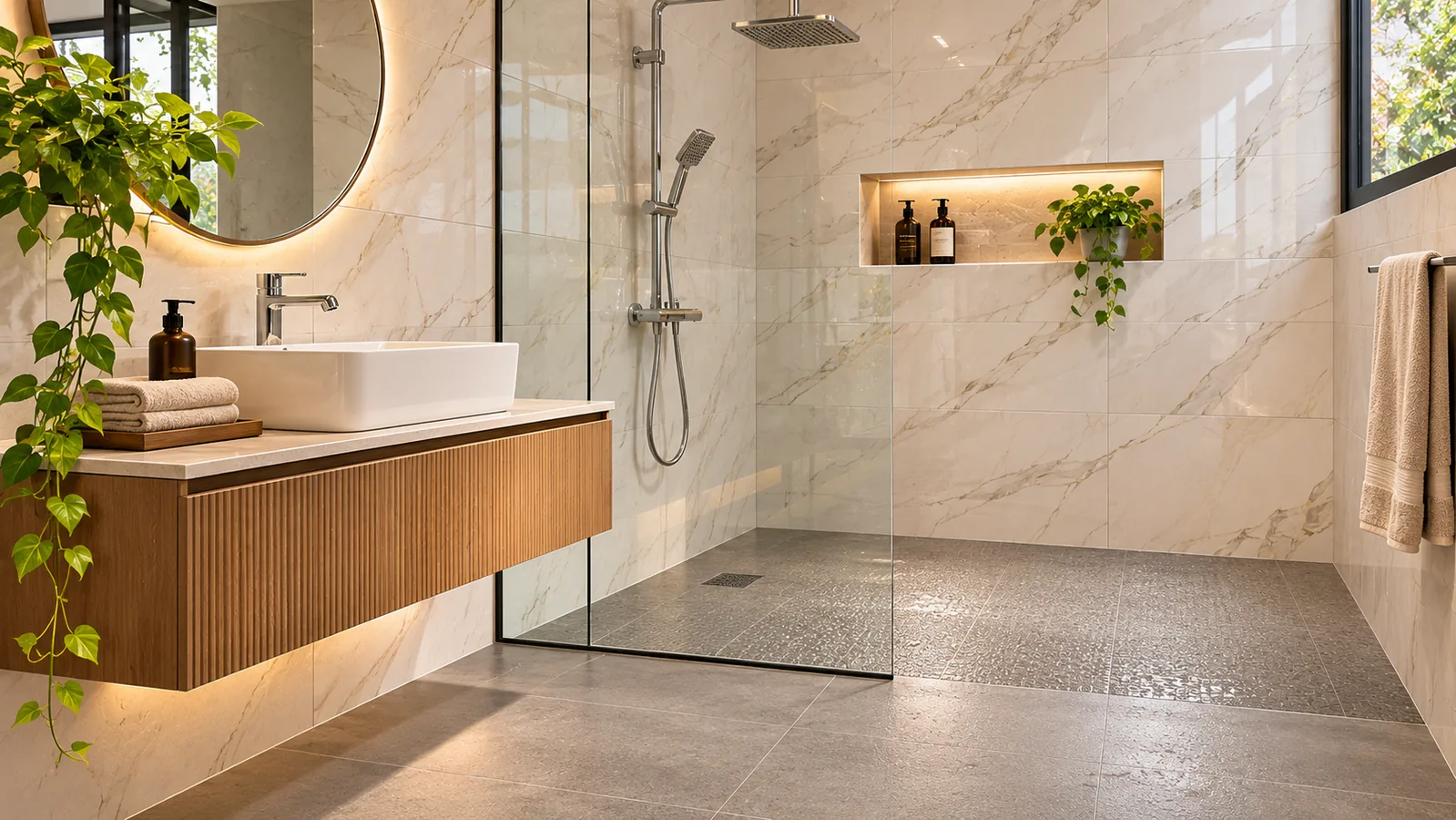
Start with the wet zone, not the picture. Your shower floor, the area near the WC and the doorway are where people slip, so these three spots need a rated anti-skid surface. Rollence's own guidance for wet and external floors is a DIN 51130 slip rating of R10 or R11, and that is a sensible target for any bathroom floor.
Walls are more forgiving. A glossy tile on the wall gives you light and easy cleaning, and PGVT (polished glazed vitrified tile) works well there. PGVT stays on walls only, never on bathroom floors.
Size comes next. A 600x600 tile suits most floors. A 300x300 ceramic tile is the one ceramic size that can go on a bathroom floor, while 300x450 and 300x600 ceramic tiles stay on walls. If you are still deciding between formats, our guide on how to choose the right tile size for every space covers room by room logic.
| Part of the bathroom | Safe tile choice | Avoid |
|---|---|---|
| Floor (wet zone) | Matte or rain-drop texture GVT, 300x300 ceramic | Glossy, polished, satin matte |
| Floor (dry zone) | Matte GVT, 600x600 | Mirror-polish tiles near the shower |
| Walls | Glossy ceramic, PGVT, matte GVT | None for walls, but mind the grout colour |
| Shower niche and ledge | Same tile as wall, cut neatly | Mixing finishes in the niche |
Which bathroom tiles design ideas fit a budget of Rs 25 to Rs 75 per sq ft?
This band covers 300x300 ceramic tiles (about Rs 25 to Rs 45 per sq ft) and 600x600 GVT (about Rs 40 to Rs 75 per sq ft). The rates are indicative, ex-GST, for branded tiles as listed in a May 2026 price guide. Good design here comes from restraint, not from extra tile types.
1. Light grey matte floor with a matching wall
A single light grey in 600x600 matte on the floor and wall makes a small bathroom look continuous. It hides water marks better than white and costs less than any pattern.
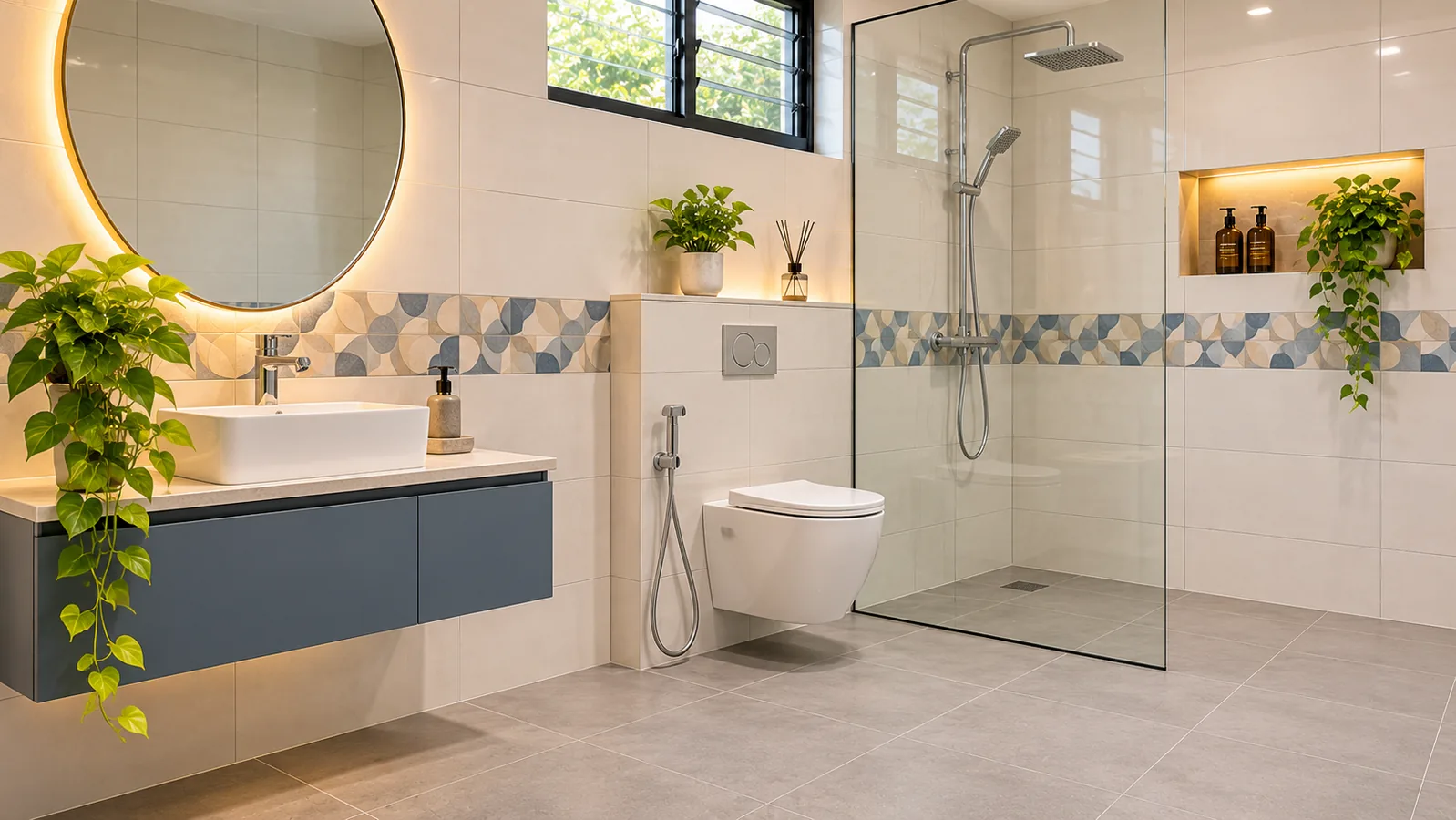
2. White wall with a coloured border strip
Run plain white tiles to 1,200 mm and add one coloured strip as a border. The strip is a few tiles only, so it adds colour without adding much cost.
3. Glossy lower wall, matte upper wall
Use a glossy tile up to 1,200 mm where splashes happen and a matte tile above it. The split line is where your eye rests, so keep it level with a window sill or a niche.
4. 300x300 ceramic floor with a dark grout line
This is the small-bathroom classic. The 300x300 ceramic tile is the only ceramic size that goes on a bathroom floor, and its many joints add natural grip.
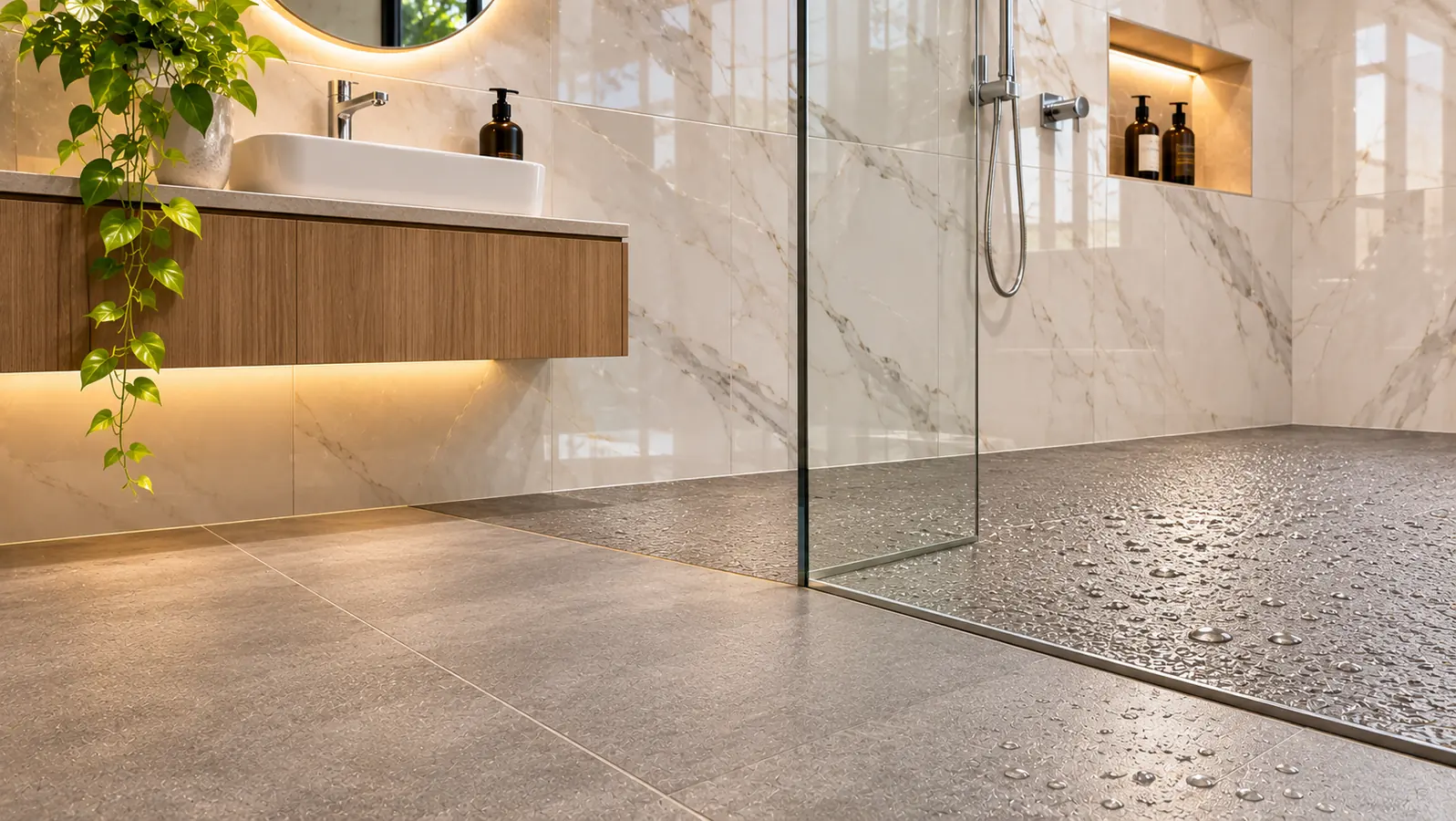
5. Rain-drop texture in the shower zone
A matte tile with a rain-drop surface gives excellent grip underfoot. Use it only in the shower zone and pair it with a plainer tile in the dry zone.
6. One-colour wall from floor to ceiling
Taking a pale beige or ivory tile all the way up avoids the "cut-off" look of half-height tiling. It also makes the ceiling feel higher.
7. Geometric print as one feature wall
Choose the wall behind the wash basin. A printed ceramic tile there, with plain tiles on the other three walls, keeps the bathroom calm and the budget low.
8. Stone-look matte floor in a mid-grey
A matte stone-look surface in 600x600 hides footprints and soap marks. Check the surface texture with your palm. If it feels grippy, it will stay grippy when wet.
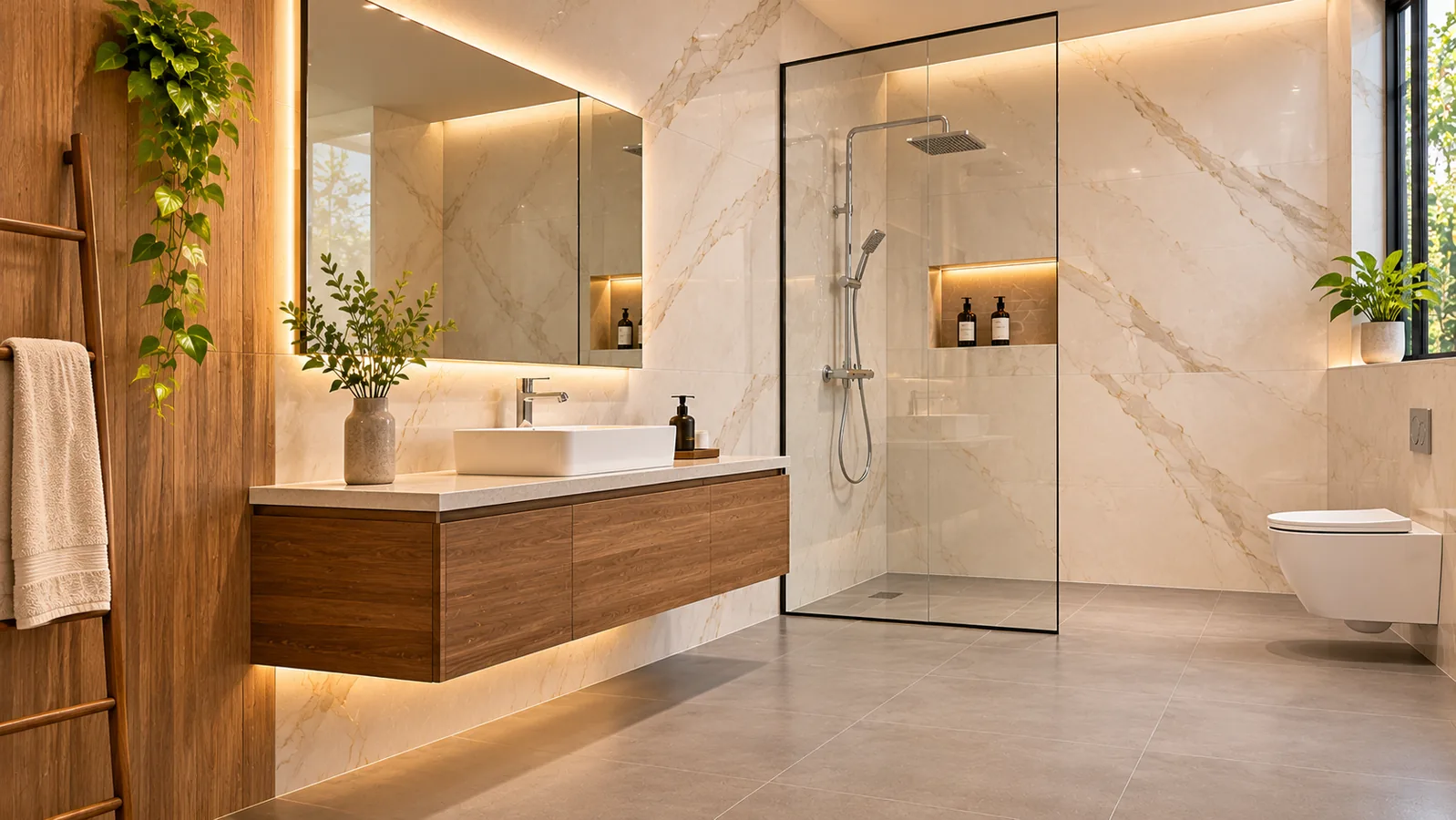
What can you do with Rs 80 to Rs 140 per sq ft?
At this level you move to large formats. A 800x1600 GVT or PGVT sits at roughly Rs 80 to Rs 140 per sq ft in the same price guide, and the fewer joints are what you are paying for. For a 100 sq m floor, a 600x1200 tile needs about 139 pieces, while an 800x1600 needs about 78, so grout lines drop sharply.
9. Full-height 800x1600 wall panel behind the shower
One tall tile from floor to near ceiling leaves almost no horizontal joint. In a 7 ft wall, a single 1600 mm tile covers over half of the height.
10. Marble-look PGVT on the vanity wall
A polished marble-look surface reflects light and suits the wall behind the mirror. Keep it on the wall only, since PGVT does not belong on a wet floor.
11. Wood-look tile on one wall
A wood-look tile printed on vitrified body gives warmth without any timber going near water. Use it on a dry wall away from the shower for a spa feel.
12. Carved matte wall with glossy veins
A matte surface with glossy veins that you can feel adds depth under a downlight. It catches dust in the grooves, so use it on a wall that does not get splashed.
13. Dark matte walls with a light floor
Deep green, charcoal or navy on the walls and a light floor looks bold and photographs well. Make sure the room has enough daylight or a bright mirror light.
14. Floor and wall in the same tile
When floor and wall use the same tile in matte, the room reads as one block. This works best with a 600x600 or 800x1600 GVT in a quiet colour.
15. Large-format niche tile
Cut the shower niche from the same tile as the wall and keep the niche edges tight. A mismatched niche is the first thing visitors notice.
16. Border-free wall with a tiled ledge
Skip a decorative border and add a tiled ledge at 1,000 mm instead. It holds shampoo bottles and doubles as the visual break in the wall.
17. Contrasting floor, plain wall
A patterned matte floor against a plain wall is the easiest way to add character. Keep the pattern size small in a small bathroom so it does not crowd the room.
For colour decisions across these ideas, tile colour psychology for interior spaces explains what greys, greens and beiges do to the mood of a small room.
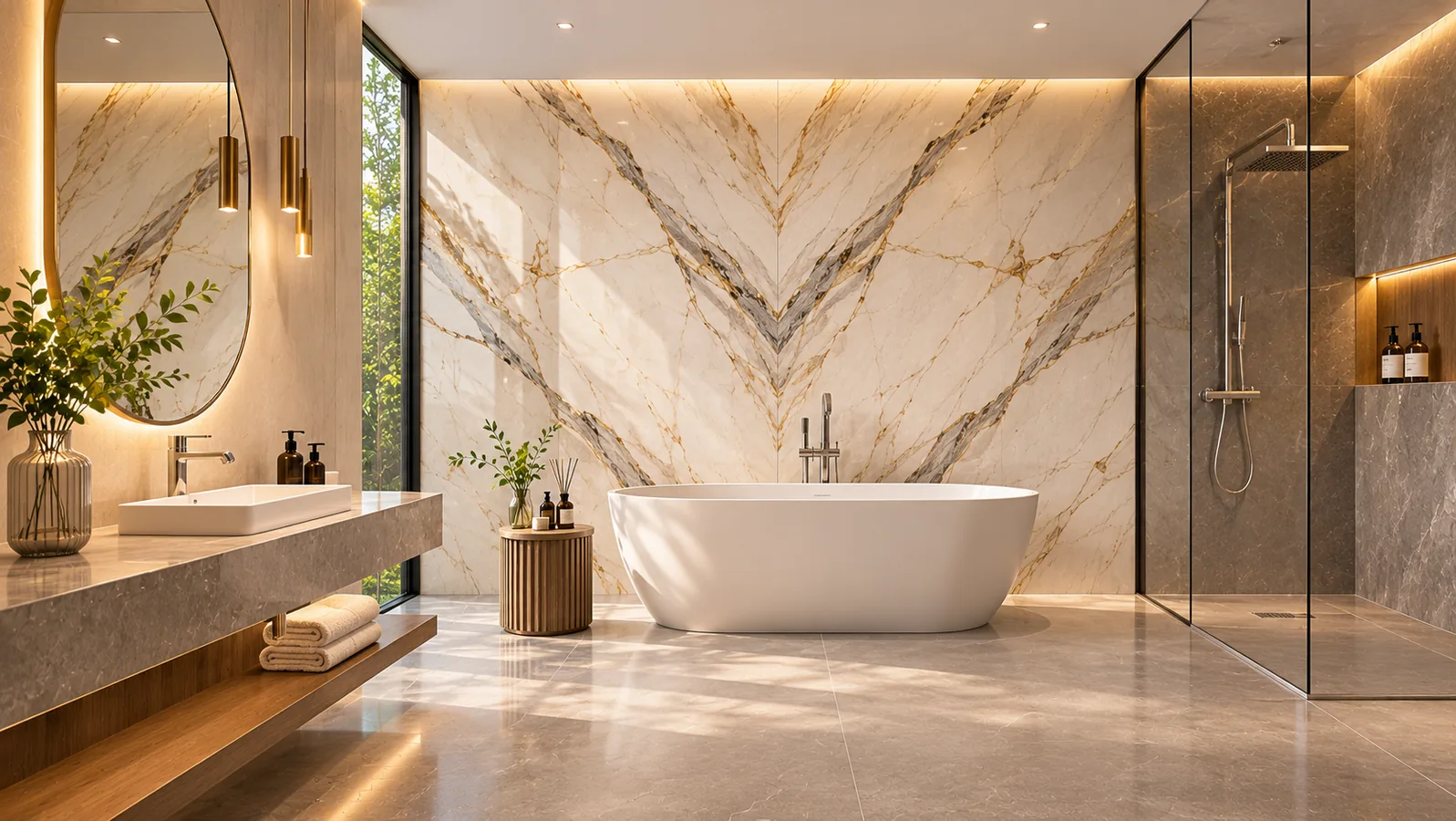
What are the top-end bathroom tiles design ideas above Rs 140 per sq ft?
Above Rs 140 per sq ft you are buying size, texture and surface depth. Slab-size tiles, deep texture and rich veining raise the rate. The same price guide lists a slab tile in the 800x1600 class at Rs 120 to Rs 180 per sq ft, and bigger sizes cost more.
18. Slab-size wall with almost no joints
A 1200x2400 or 800x2400 tile on a feature wall looks like a single stone surface. Plan the cut layout before the tiles are ordered.
19. Bookmatched vein pattern
Two adjacent tiles with matching vein flow create a mirrored pattern. Ask for the print sequence from the same batch to get the flow right.
20. Textured wall with a smooth floor
A deeply textured wall catches light and a smooth, matte floor keeps the bathroom safe. Both can be in one colour family so the contrast stays quiet.
21. Two-colour floor with a transition line
Use a darker tile in the shower zone and a lighter one in the dry zone. The line between them also marks where the shower screen goes.
22. Full-height mirror wall in glossy tile
A high-gloss wall behind the vanity bounces light into a dark bathroom. Keep it at the vanity wall only, as high-gloss shows every water spot.
23. Marble-look floor in matte, wall in glossy
The same marble pattern in two finishes ties the room together. The floor stays safe because it is matte, and the wall gets the shine.
24. Hotel-style tonal bathroom
Pick three tones of the same colour in matte and glossy. Use the darkest on the floor, the mid-tone on three walls and the lightest on the ceiling-height wall.
25. Wall-to-ceiling slab with a recessed shower
Take the slab right up to the ceiling to get a spa-like block of stone-look surface. Waterproofing behind the tile matters more than any finish at this level.
For a look at how finishes change the feel of a space, see different types of tile finishes and their visual impact on interior design.
Which finish goes where in a bathroom?
| Finish | Floor (wet) | Floor (dry) | Wall |
|---|---|---|---|
| Matte | Yes | Yes | Yes |
| Rain drops | Yes, best grip | Yes | Rare |
| Glossy | No | Avoid | Yes |
| High glossy or polished (PGVT) | No | No | Yes, wall only |
| Satin matte | No | Use with care | Yes |
| Carved or textured | Only if rated anti-skid | Yes | Yes |
How much tile does a bathroom need, and how do you plan the layout?
Measure the floor and the wall area separately, and add the wall area only up to the height you plan to tile. A typical 5x8 ft bathroom has about 40 sq ft of floor and 160 to 200 sq ft of wall if tiled to the ceiling. Buy 8 to 10 per cent extra for cuts, and 12 to 15 per cent if the layout is diagonal or has a pattern to match.
Pick the tile before the plumber marks the points. Large tiles look best when the pipe holes fall at the centre of a tile or on a joint, not close to an edge. Ask your tiler to dry-lay one row so you can see where the cuts land.
Order everything from the same batch. Shade and size can vary slightly between production lots, and a tile from a later lot can show as a patch under bathroom lights. Rollence prints and fires in lots and tests every batch before dispatch, so keeping one lot number across the order is the simplest way to stay consistent.
| Bathroom size | Floor area | Wall area (to ceiling) | Tiles needed at 600x600 (floor) |
|---|---|---|---|
| 4x6 ft | about 24 sq ft | about 130 sq ft | about 7 to 8 |
| 5x8 ft | about 40 sq ft | about 170 sq ft | about 12 |
| 6x9 ft | about 54 sq ft | about 210 sq ft | about 16 |
How do you keep grout, waterproofing and upkeep right?
Tiles only protect the wall if the layer behind them is sound. Waterproofing goes on the slab and up the walls to at least 1,200 mm (and the full height in the shower) before any tile is laid. A leak behind the tile shows up on the ceiling below, and fixing it means breaking the tiles.
Grout matters as much as the tile in a wet room. Cement grout is porous and picks up soap and mildew, so epoxy grout is the better pick for shower walls and floors. It costs more per kg, but it needs no sealing.
Clean matte floors with a soft brush and a mild floor cleaner once a week. Acid cleaners dull glossy walls and eat cement grout, so avoid them. Wipe the glossy walls with a squeegee after a shower to keep the water spots away.
How do architects and dealers read these ideas?
Architects usually ask for three numbers: water absorption, slip rating and size tolerance. A GVT body absorbs about 0.05 per cent water, which is why it is safe on bathroom walls and floors in damp climates. Slip rating applies to the floor tile, and size tolerance decides how tight your grout joint can be.
Dealers and contractors think in boxes. A 600x600 box usually has 4 tiles (1.44 sq m), and an 800x1600 box has 2 tiles (2.56 sq m). Check the box coverage before you order so that the count matches your plan.
What should importers and project buyers know about bathroom tiles?
The same rules apply to hotel and apartment projects abroad. Buyers fitting out hotel bathrooms in Basra or Baghdad often shortlist an 800x1600 porcelain tiles supplier in Iraq who can match shades across several containers. Rollence makes these tiles at its own factory in Matel, near Wankaner in Morbi, and tests every batch to ISO 10545 before dispatch.
What are the common mistakes in bathroom tile selection?
The first mistake is picking a glossy floor tile because it looks bright in the showroom. Wet glossy tiles are slippery, and the risk shows up in the first monsoon.
The second is skipping slope. A floor needs a gentle fall toward the drain, usually about 1 in 100, so water does not sit near the door.
The third is dark grout on a light tile in a small room, which breaks up the surface into a grid. Match grout to the tile or go one shade darker.
The fourth is ordering the exact quantity. Add 8 to 10 per cent for cuts, and more for diagonal layouts.
FAQs on bathroom tiles design
Which tile is best for a bathroom floor in India?
A matte 600x600 GVT or a 300x300 ceramic tile with an anti-skid surface works best. Look for a DIN 51130 rating of R10 or R11 for the wet zone.
Can I use glossy tiles in the bathroom?
Yes, on walls. Do not use glossy, high-glossy, polished or satin matte tiles on a wet floor, because they become slippery when wet.
What size tile is best for a small bathroom?
A 600x600 tile on the floor and a 300x600 or 800x1600 tile on the wall. Fewer joints make the room look larger.
How much do bathroom tiles cost per sq ft?
A 300x300 ceramic costs about Rs 25 to Rs 45, a 600x600 GVT about Rs 40 to Rs 75, and an 800x1600 GVT or PGVT about Rs 80 to Rs 140. These are indicative ex-GST rates for branded tiles in 2026.
Can I use the same tile on the floor and wall?
Yes, if the tile is matte and rated for floors. A 600x600 or 800x1600 GVT in matte works on both.
Should the bathroom wall tiles go up to the ceiling?
Full height is cleaner and avoids the cut-off look. Half-height tiling saves money but needs a neat top edge.
Next step for your bathroom tile list
Once you have a shortlist, send the size, finish and quantity to the Rollence team at info@rollence.in. Rollence is among the porcelain tiles manufacturers in Morbi that make GVT and PGVT in sizes from 600x600 to 1200x2800 mm, so you can plan floor and wall from one range.
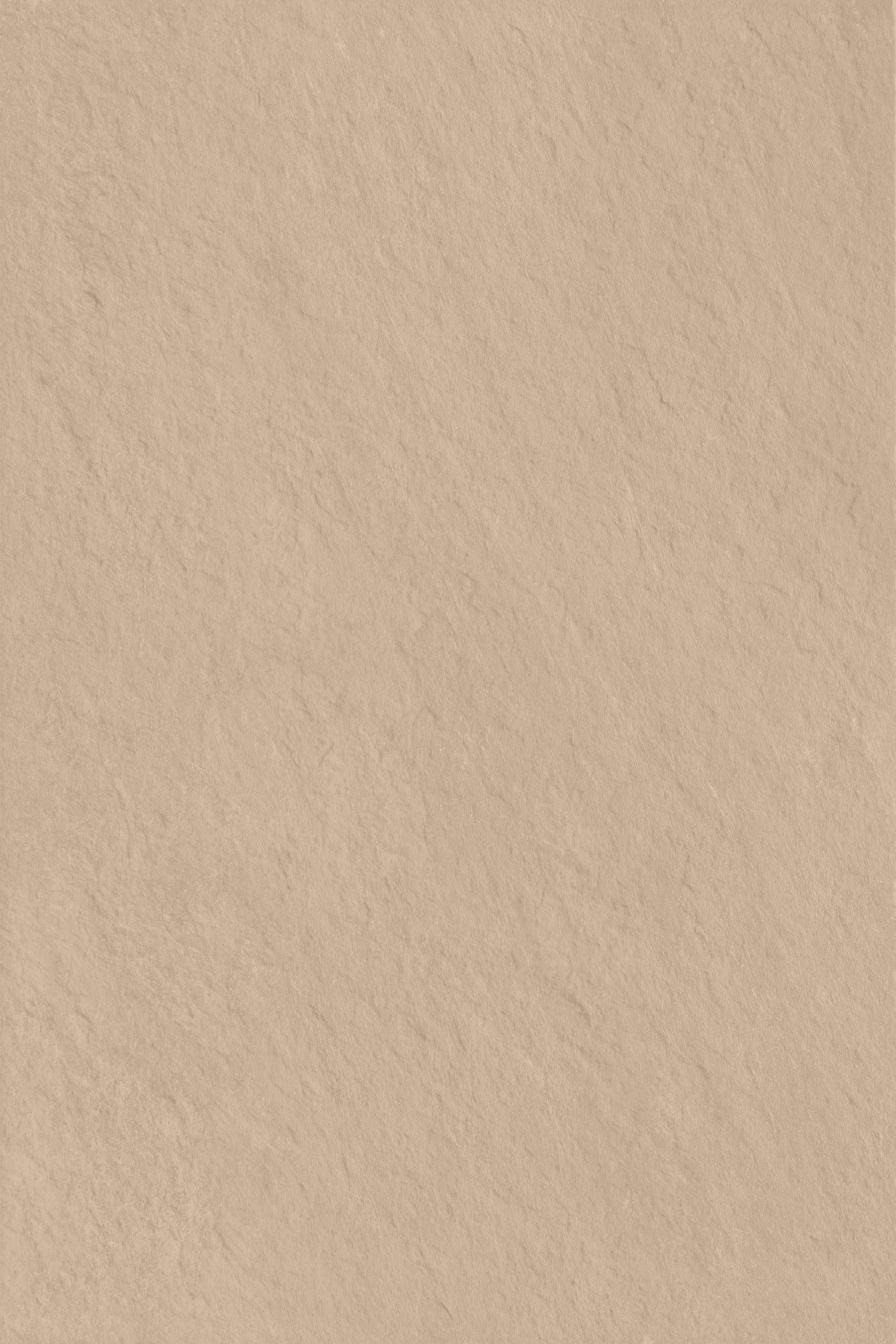
Featured Tile Designs


Ready to Secure High-Performance Tiles for Your Project?
Get physical samples across our premium porcelain series, plus access to expert advice, to lock your scheme with confidence.