


The front of a house is judged in three seconds from the road, so elevation tiles should be planned in zones, not as one material over the whole wall. A strong plinth, one dominant main wall and a small accent on the pillar and name panel give the cleanest result, and the rest is a matter of picking tiles that survive sun and monsoon.
That zone-by-zone approach is the same one used across tile design ideas for homes and commercial spaces, and here it is applied to the front wall, with the weather in mind.
| Quick answer: For elevation tiles, use textured, low-water-absorption tiles outdoors. Stone-look or brick-look wall tiles (including High Depth punch tiles in 300x450 and 300x600, wall only) suit the main wall, and a rough GHR or matte GVT suits the plinth and steps. Fix large formats with mechanical support above ground level, and keep glossy tiles off the facade. |
What makes a tile right for an exterior wall?
An exterior wall faces sun, rain, dust and temperature swings that an interior never sees. A tile that looks fine in a drawing room can chalk, stain or loosen within two monsoons outside.
Four checks decide the pick.
Water absorption comes first. A vitrified tile absorbs about 0.05 per cent water, while ceramic wall tile absorbs 12 to 16 per cent. Ceramic elevation tiles work on sheltered walls, and vitrified bodies are the safer choice for exposed ones.
Surface comes second. A textured or matte face hides dust and rain streaks. A glossy face shows every watermark and reflects harsh afternoon sun.
Size and weight come third. Small wall tiles stay light and can be fixed with adhesive. Large tiles carry weight and need mechanical support at height.
Movement joints come fourth. Sun heats the wall by day and it cools at night, so the tiled surface needs joints every 3 to 4 m to take up the movement.
| Zone | Tile direction | Size options | Finish |
|---|---|---|---|
| Plinth and steps | Rough, high-grip, low absorption | 400x400, 500x500, 600x600 GVT | GHR, rustic matte |
| Main front wall | Textured wall tile or vitrified cladding | 300x450, 300x600, 600x1200 | Matte, texture, High Depth punch |
| Gate pillar | Same as wall or a contrast | 300x600 or 600x600 | Textured, matte |
| Name panel | Plain or marble-look | 600x600 or 800x1600 | Matte |
| Parapet cap | Rough, with a drip edge | Cut from floor tile | Matte |
Which elevation tiles design ideas suit the main front wall?
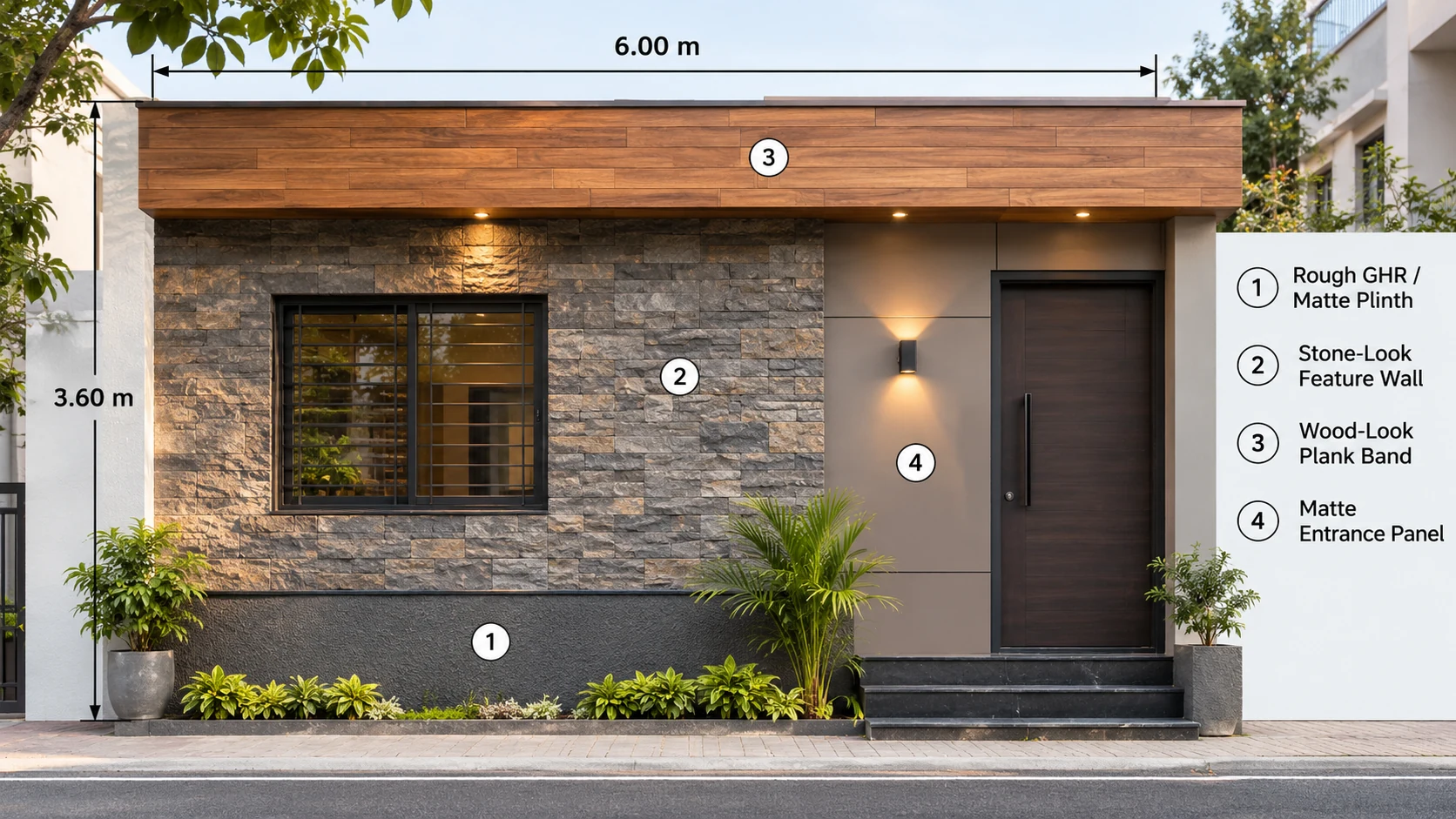
Stone-look cladding
A stone-look tile in grey or sand, laid in a staggered pattern, gives the wall depth. A High Depth punch tile has a surface relief of 2.5 to 5 mm, and it is available only in 300x450 and 300x600. These belong on walls and elevation only, never on floors.
Brick-look cladding
A brick-look wall tile in red or burnt orange suits compact houses and row houses. Use it on a single wall or a pillar, not on the whole front, or it will look heavy.
Wood-look plank band
Wood-look planks in 200x1200 vitrified give warm lines without timber going near rain. Use a horizontal band on the first-floor level to break up a tall plain wall.
Marble-look entrance panel
A matte marble-look tile on the wall around the main door frames the entry. Keep it small, since large polished surfaces collect dust and glare in sunlight.
Large-format plain wall
A large tile in a plain colour gives a clean, flat front. This is where the size choice matters most, and large format tiles, their sizes, benefits and applications explains where each size works.
Which tiles work for the plinth, steps and gate pillar?
The lower 600 to 900 mm of the house takes the heaviest abuse. Splashback from rain, scooters, and dogs all hit it.
The plinth should use a rough, strong tile. A GHR (glaze high resistance) GVT has a stone-like texture and works well on high-traffic floors indoors and outdoors, so it also suits steps and plinth cladding.
Entrance steps need grip first. Choose R11 or higher on the DIN 51130 scale for outdoor steps, and add a tile nosing or a grooved edge so that feet find the edge in the dark. Glossy, polished and satin matte tiles must never go on outdoor steps.
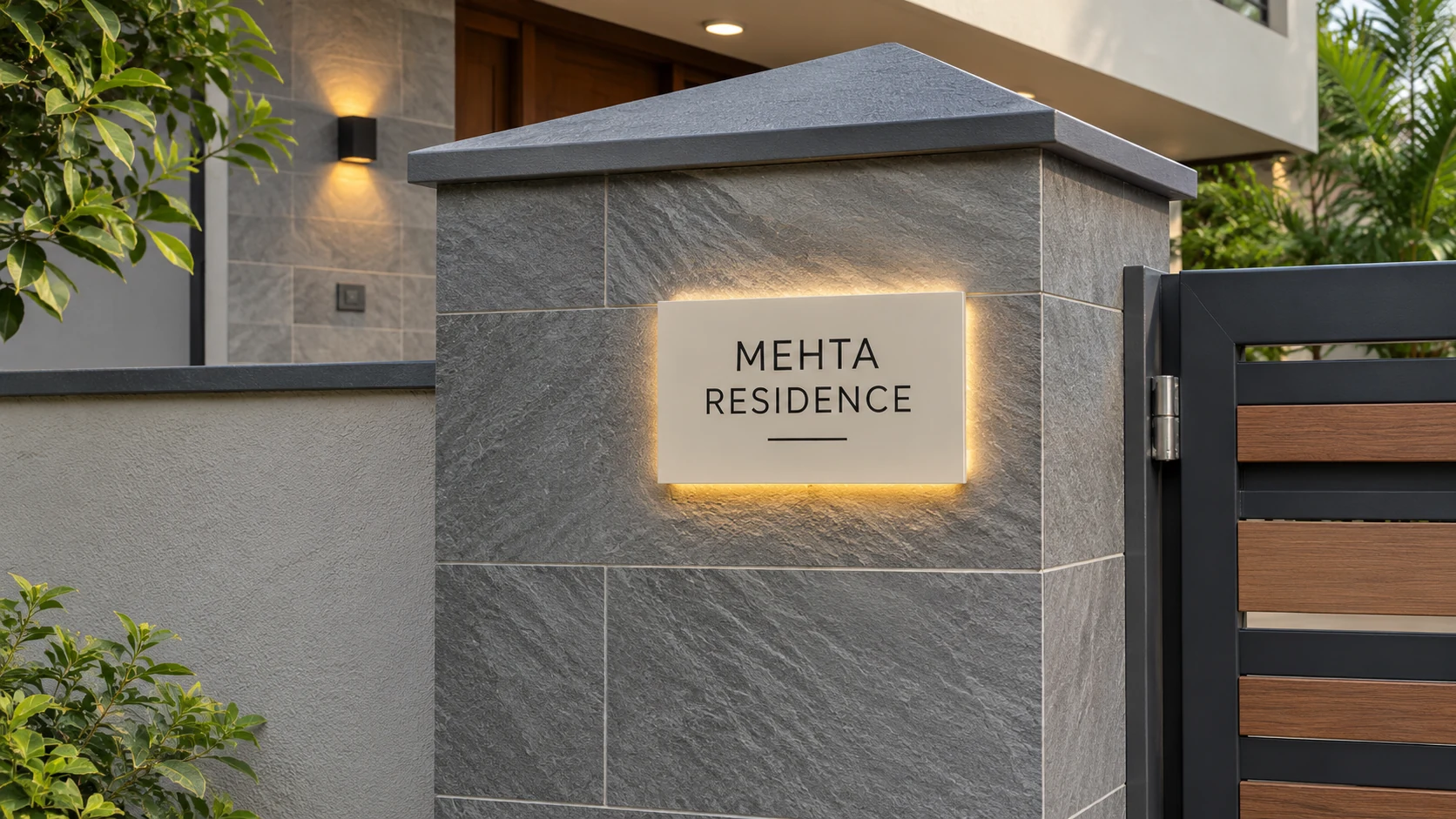
Gate pillars take light hits and carry the name plate. A contrast tile on the pillar, such as a dark grey or brown against a pale wall, brings out the entrance. Keep joints thin, and cap the pillar top with a sloped piece so water runs off.
For finish ideas that carry from walls to steps, natural finish tiles for luxury commercial flooring shows how a stone-like matte surface behaves under daily wear.
How should elevation tiles be fixed?
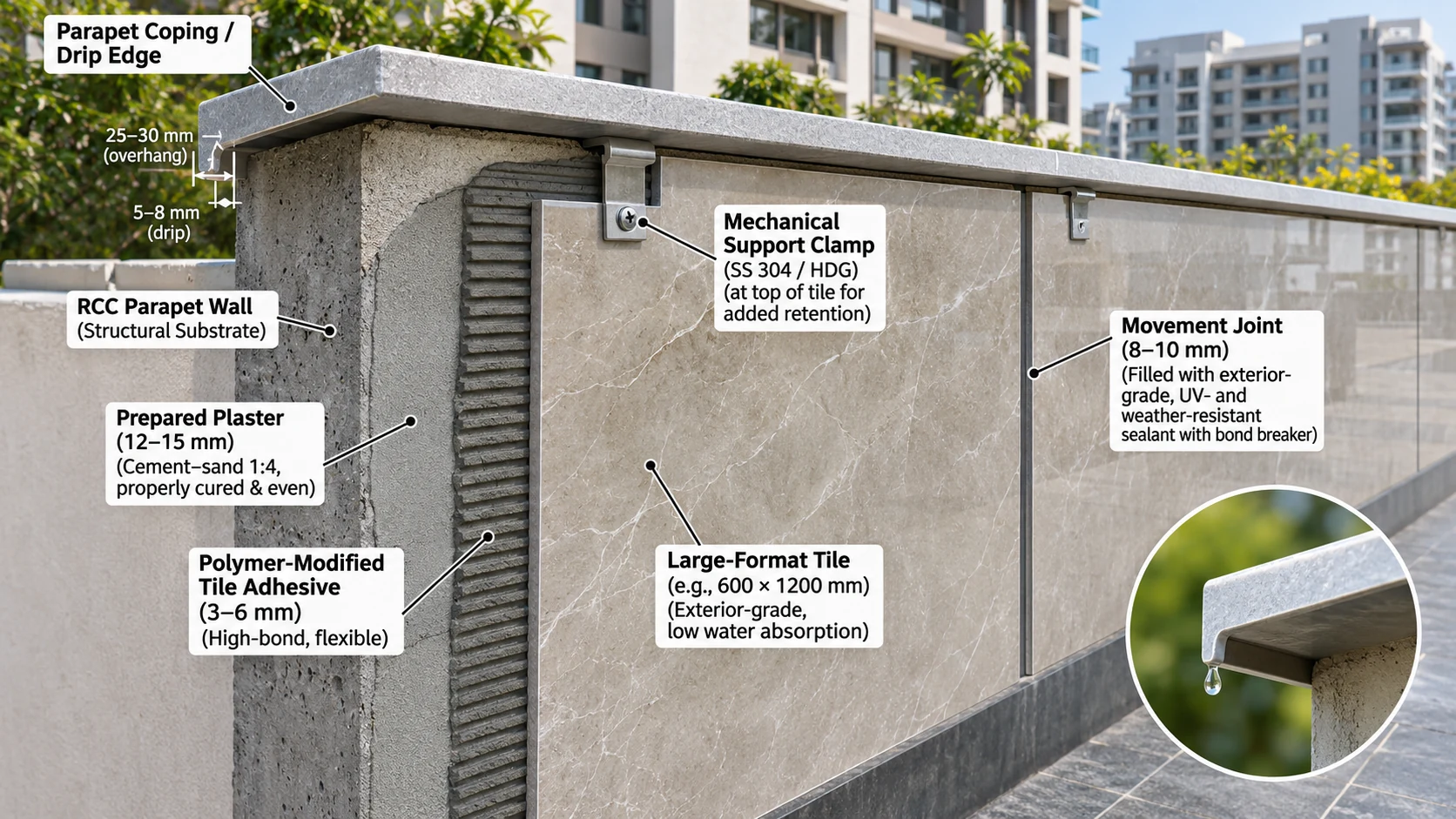
The fixing method matters as much as the tile. A poorly fixed facade tile can drop years later.
-
Check the wall. Cement plaster should be cured, flat to within 3 mm over 2 m, and free of dust and oil.
-
Use a polymer-modified tile adhesive (not plain cement slurry) on the wall, and back-butter large tiles.
-
Keep joints 3 to 5 mm wide, and fill with a weather-resistant grout.
-
Leave movement joints at 3 to 4 m intervals and at changes of material.
-
Use stainless steel or hot-dip galvanised clamps with adhesive on tiles of 600x1200 and above, and on any wall above the first floor.
-
Cure for the time stated on the adhesive pack before you remove scaffolding.
For tall buildings and large formats, a facade consultant should specify the fixing system. Large format tiles are heavy, and the adhesive alone should not carry them at height.
What colours work for Indian elevations?
Light colours stay cooler in heat and show less sun fading. Cream, sand and pale grey are safe for the main wall. Accent colours go on pillars, bands and the name panel.
Dark tones absorb heat and show dust, so use them in small areas or on shaded sides. A dark wall facing the west sun in a place like Ahmedabad or Nagpur can heat up enough to stress the adhesive.
For a home facing a dusty main road, a mid-tone textured tile hides dust better than white and needs fewer washes. Coastal homes should prefer vitrified bodies, since salt air and wet walls punish porous tile.
| Climate | Wall tile pick | Reason |
|---|---|---|
| Hot and dry (Gujarat, Rajasthan) | Light, textured vitrified | Reflects heat, hides dust |
| Humid coast (Mumbai, Chennai, Kochi) | Vitrified, low absorption | Salt and damp resist |
| Heavy monsoon hill areas | Textured, quick-drying surfaces | Fewer stains and moss |
| Metro roadside | Mid-tone, textured | Hides dust and exhaust marks |
How does the front wall relate to the rest of the house?
A good elevation continues into the entrance lobby and the porch. If the porch floor uses a tile in the same colour family as the front wall, the house reads as one design. Match the family, not the finish, since the porch floor needs grip and the wall does not.
Names and numbers should sit on a plain panel. A busy tile behind a name plate makes it hard to read from the gate.
What do architects and builders ask about elevation tiles?
Architects ask for fixing details, expansion joints, and an exact thickness and weight per sq m. Builders ask for batch consistency across the whole front, since shade variation shows from the road.
Dealers need to know that High Depth tiles come only in wall sizes and that vitrified claddings come in bigger sizes. For housing societies and commercial frontages, lock the full quantity from one batch and add 8 to 10 per cent for cuts and breakage.
Buyers abroad ask the same questions for villa developments and hotel fronts. Importers in Iraq who compare a 1200x1800 porcelain tiles supplier in Iraq for cladding and floors look at thickness, tolerance and packing, and Rollence ships 1200x1800 and 1200x2400 tiles from Mundra, Kandla and Nhava Sheva against LC or TT payment.
How much tile does an elevation need, and how do you look after it?
Measure each zone separately: plinth, main wall, pillar and any band. For a typical 20 ft wide, 10 ft high front wall with a door and two windows, the net tiled area is about 140 to 160 sq ft after you deduct openings. Add 10 per cent for cuts and breakage on straight layouts and up to 15 per cent for stone-look or brick-look patterns that need random mixing.
Mix tiles from several boxes while fixing. A stone-look tile has several print faces, and mixing boxes spreads the faces evenly across the wall so that no patch repeats.
Upkeep is simple but regular. Rinse the wall with water after the monsoon to remove dust and algae, and use a soft brush on textured faces. Check grout lines each year and refill cracked joints before water gets behind the tile. Keep creepers and plants from rooting on the tiled surface, since roots lift joints.
What mistakes spoil an elevation tile job?
Using indoor glossy tiles outside is the first mistake. They stain, glare and slip.
Skipping movement joints is the second. Sun heat will lift a rigid tiled sheet over time.
Using High Depth tiles at the plinth is the third. They are wall tiles, and the relief collects dirt and gives no safe footing.
Forgetting a drip edge on the parapet is the fourth. Water that runs down the face leaves black streaks within a season.
FAQs on elevation tiles
Which tiles are best for the front wall of a house?
Textured, low-absorption tiles in matte or stone-look finish. Vitrified bodies are better on exposed walls than ceramic.
Can I use floor tiles on an exterior wall?
Yes, a matte vitrified floor tile can be used on a wall if the fixing is right. Use mechanical support for large sizes and tall walls.
What is a High Depth tile?
A tile with a surface relief of 2.5 to 5 mm that gives a stone or brick look. It comes in 300x450 and 300x600 and is for walls only.
Which tile is best for a house plinth?
A rough GHR or matte GVT with low water absorption and grip. It handles splashes and knocks better than a smooth tile.
Do glossy tiles work on an elevation?
They are not a good idea. They show watermarks, glare in sunlight and age badly outdoors.
How often do elevation tiles need cleaning?
A wash with water and a soft brush after the monsoon is enough for textured tiles. Avoid acid cleaners on grout.
Planning an elevation with Rollence
Send your front wall height, zone plan and finish idea to info@rollence.in, and the Rollence team can suggest sizes and surface from its range. Rollence is among the porcelain tiles manufacturers in Morbi, and its GVT and PGVT tiles are tested to ISO 10545 batch by batch.
Featured Tile Designs




Ready to Secure High-Performance Tiles for Your Project?
Get physical samples across our premium porcelain series, plus access to expert advice, to lock your scheme with confidence.