


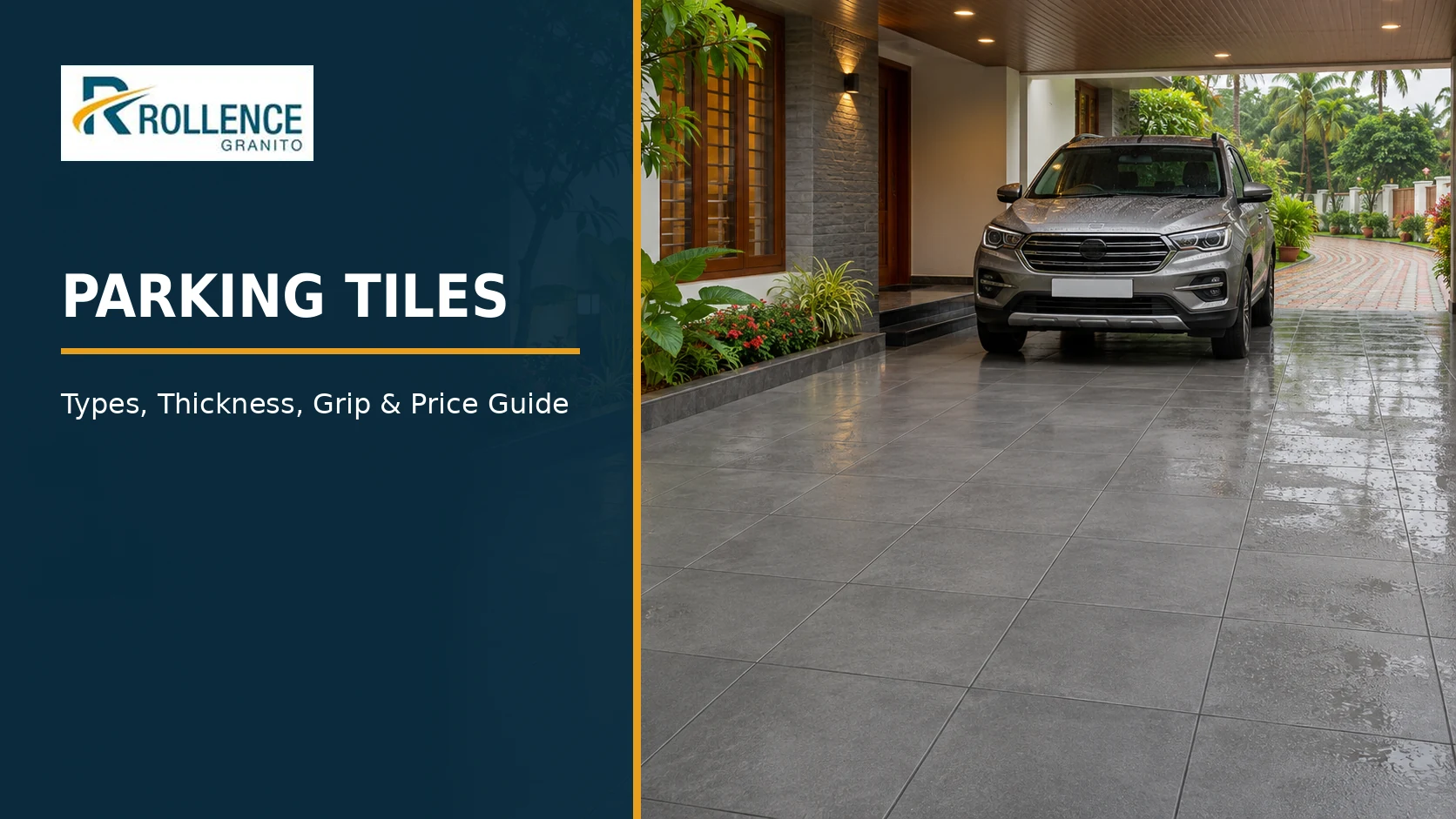
A car porch needs a different tile from a heavy-vehicle bay, and most parking floors fail because one tile was used for both. For a home car porch, use a matte 400x400 or 500x500 vitrified or ceramic parking tile. For society lots and commercial bays, use 60 to 100 mm pavers, and in every case choose a tile with a slip rating of R11 or higher.
This guide goes through the failure points first, then the types, the 20 mm and 40 mm thickness question, anti-skid ratings and rate ranges. If you want to check a tile's strength numbers yourself, the note on key technical properties of porcelain tiles explains water absorption and breaking strength in plain terms.
| Quick answer: Parking tiles for homes are usually 400x400 or 500x500 mm in a matte or rustic finish, 9 to 12 mm thick in vitrified or ceramic, or 20 to 40 mm thick in concrete. Society lots and commercial bays use 60 to 100 mm interlocking pavers. Pick R11 to R13 slip rating, and avoid glossy, polished and satin matte tiles outdoors. |
Where do parking tiles actually fail?
Before choosing a tile, know what breaks it. Most failures are not about the tile at all.
| What you see | Likely cause | Fix |
|---|---|---|
| Tiles rocking or hollow under foot | Weak mortar bed or no bed under the tile | Lay on a full 25 to 30 mm mortar bed over PCC |
| Cracks across the tile in a line | Base settled or load too high for the thickness | Compact the base, use a thicker tile |
| Corners chipping | Joints too tight, no room for expansion | Keep a 4 to 5 mm joint and fill with sand or grout |
| Slippery after rain | Glossy or polished surface | Replace with a matte or rustic tile of R11 or higher |
| Green slime in joints | Poor slope, water sitting | Slope the floor 1 in 80 to 1 in 100 toward a drain |
| Stains from oil | Porous surface | Choose a low-absorption vitrified body |
Notice that three of the six causes sit under the tile. A good tile on a poor base fails sooner than a basic tile on a proper base.
What types of parking tiles are used in India?
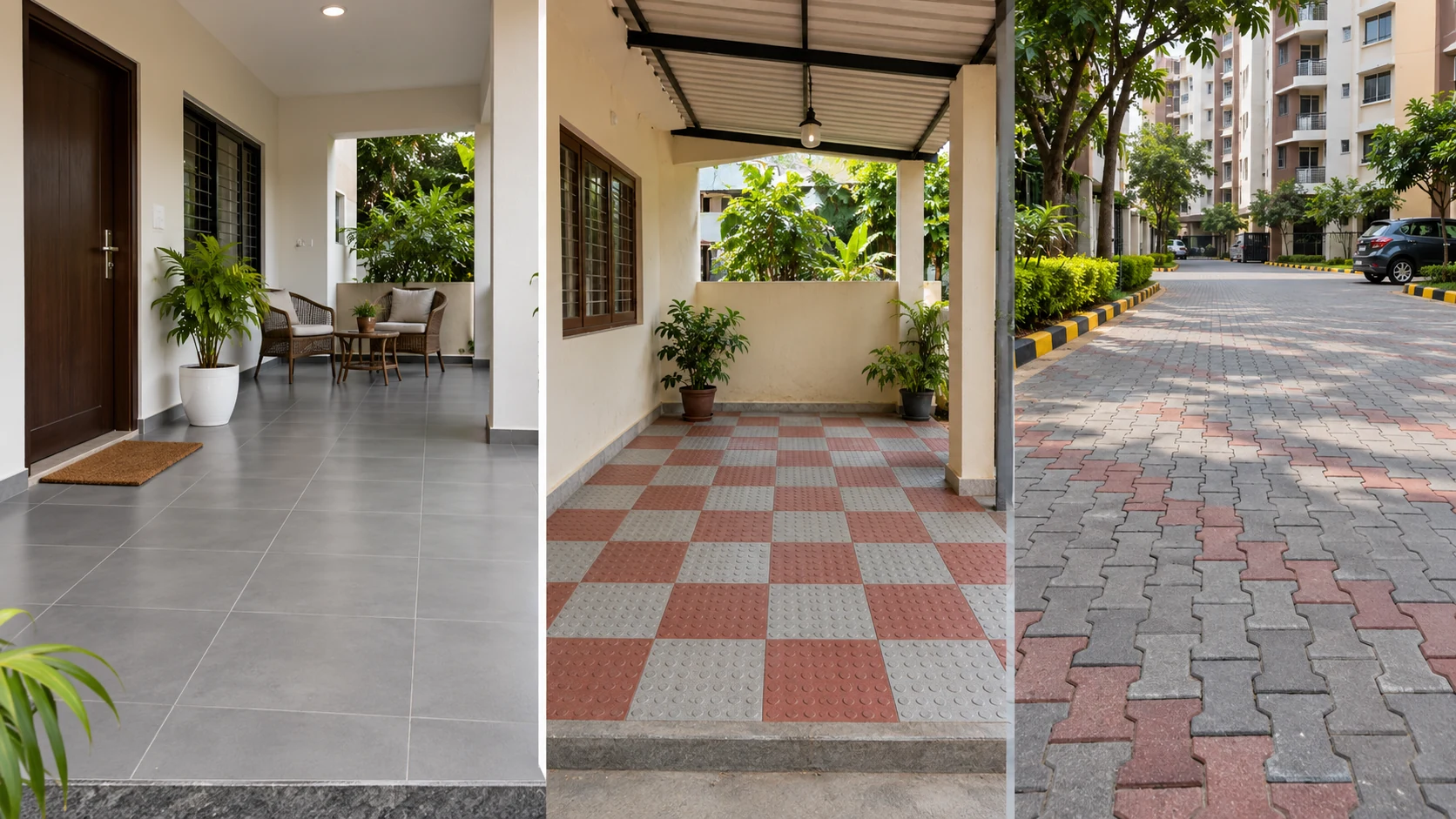
There are four families in common use. Each has a clear job.
Ceramic and vitrified parking tiles (400x400, 500x500)
These are the standard home parking tiles. They come in matte, rustic and textured faces with a thickness of about 9 to 12 mm. A 400x400 and a 500x500 are floor-only sizes and work best outdoors, in parking, balconies and terraces.
Vitrified versions absorb about 0.05 per cent water, so oil and rain do not enter the body. Ceramic versions absorb 12 to 16 per cent and are weaker, so use them only in covered, light-duty porches. A 400x400 matte vitrified parking tile sells at about Rs 55 to Rs 60 per sq ft in current online listings.
Concrete parking tiles (20 mm to 40 mm)
Concrete or cement tiles with a chequered or grooved face are the old standby for low-budget porches. The usual thicknesses are 20 mm and 40 mm. A 20 mm tile is fine for a two-wheeler and foot traffic, and a 40 mm tile is the common choice for light cars on a proper base.
Their weak point is porosity. They stain with oil and fade in strong sun, so seal them once a year.
Interlocking pavers (60 mm to 100 mm)
Pavers are concrete blocks that lock into each other and spread the load. An 80 mm paver is the usual size for cars and light vehicles, and a 100 mm paver is used where buses, trucks or fire tenders drive. For commercial loads, look for pavers made to IS 15658 in M35 to M40 grade.
Pavers cost about Rs 60 to Rs 150 per sq ft installed. They are the right pick for housing society driveways.
Large-format GVT for covered parking and forecourts (600x600 and above)
Large GVT tiles with a textured, high-resistance face suit covered parking, showroom forecourts and basement entries. Rollence's range starts at 600x600 and includes GHR (glaze high resistance) finishes with a stone-like texture, plus DG Matt and Papermatt options. GHR is the finish picked for high-traffic floors indoors and outdoors.
A GVT tile has a stronger body than porcelain, so it holds up under point loads from wheels better, provided the base is right.
| Type | Thickness | Best for | Indicative rate |
|---|---|---|---|
| Ceramic parking tile | 9 to 12 mm | Covered porch, bikes | Local quote, below vitrified |
| Vitrified parking tile 400x400 | about 12 mm | Home car porch | Rs 55 to Rs 60 per sq ft |
| Concrete chequered tile | 20 to 40 mm | Budget porch, light car | Local quote, usually lowest |
| Interlocking paver | 60 to 100 mm | Society lot, heavy bay | Rs 60 to Rs 150 per sq ft installed |
| GHR GVT, 600x600 and above | tile body | Covered parking, forecourt | On enquiry |
Rates are indicative, from published 2026 listings and guides, and change by city and base preparation.
Is 20 mm or 40 mm better for parking?
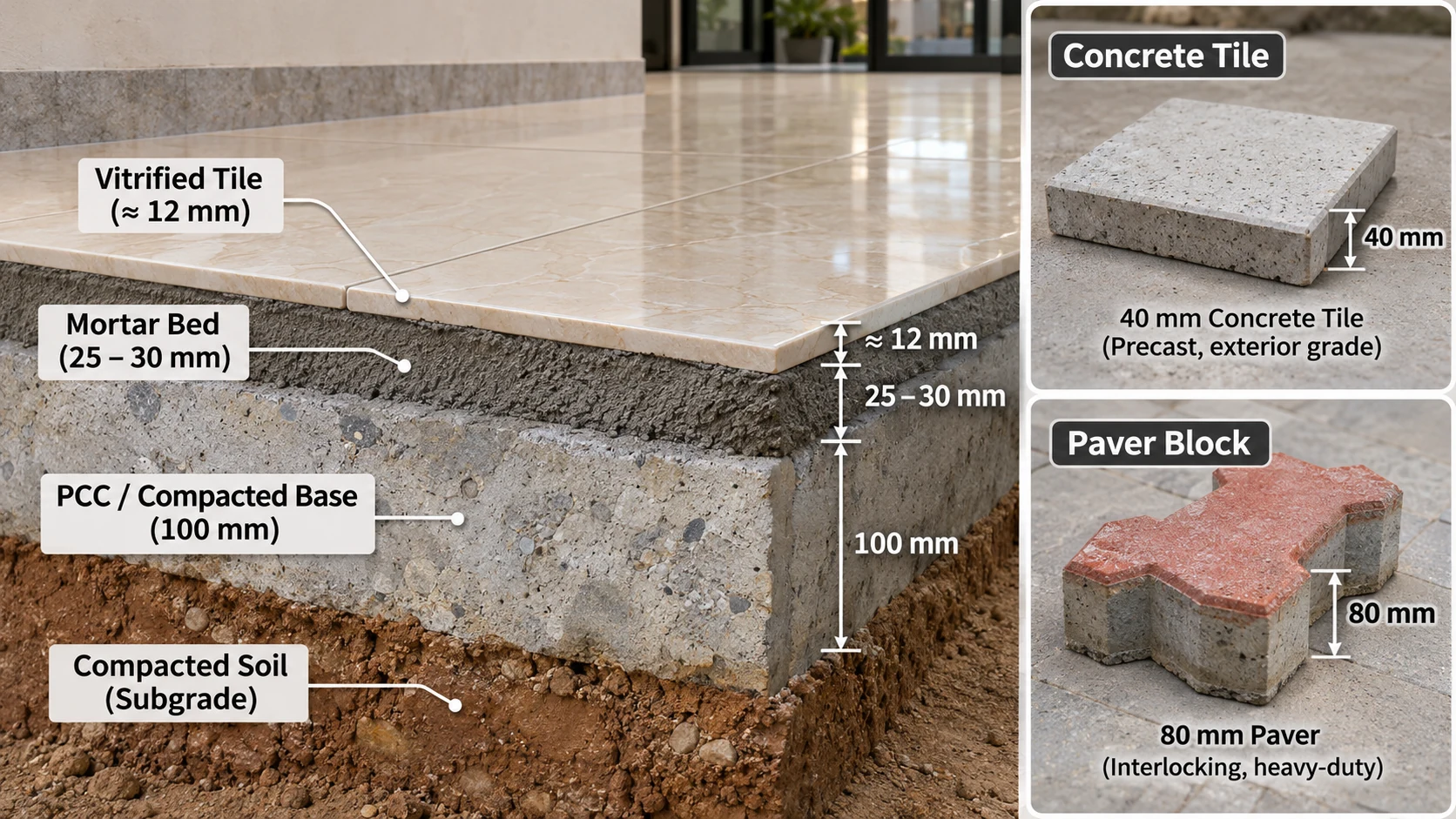
Neither number means much without the base under it. A 20 mm tile on a full mortar bed over 100 mm of PCC can carry a car, because the base carries the load. A 40 mm tile on a loose sand bed over soft soil can still crack.
As a working rule, use 20 mm for two-wheelers, footpaths and light porch use. Use 40 mm for hatchbacks and sedans parked daily. Move to 60 mm and above if an SUV turns on the same spot every day, or if the area sees delivery vans.
Ask the supplier for the breaking load figure on the datasheet. If a supplier cannot give you one, ask for a sample and test it with a load on a trial patch for a week.
For a deeper view on checking tile claims before buying, how to check tile quality before buying walks through the tests you can do on site.
Which anti-skid rating should parking tiles have?
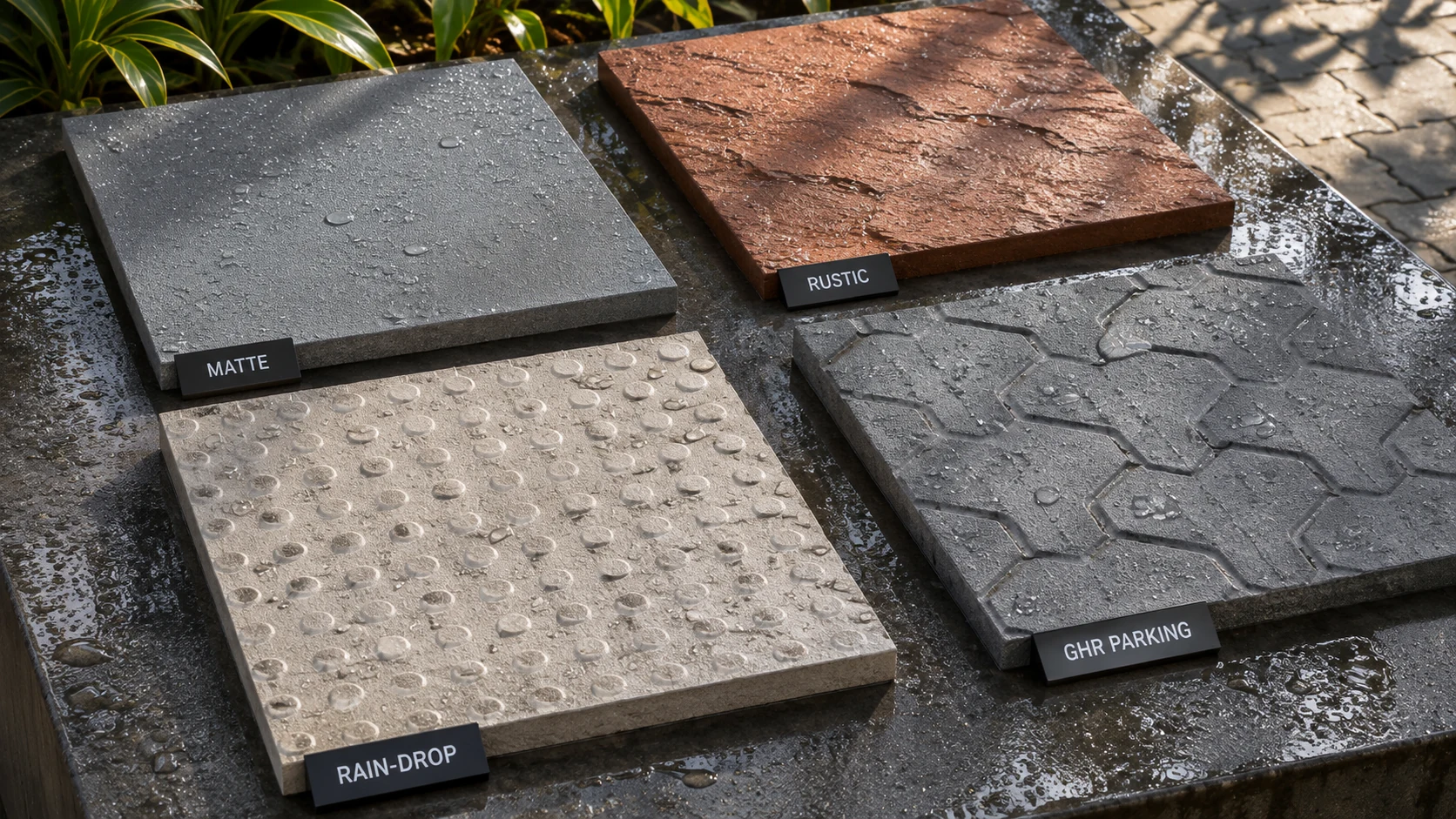
Anti-skid performance is measured on the DIN 51130 ramp test, which gives ratings from R9 to R13. Higher means more grip.
| Rating | Where it fits |
|---|---|
| R9 | Dry indoor floors only |
| R10 | Wet barefoot zones, light outdoor use |
| R11 | Wet outdoor floors, car porches, ramps with gentle slope |
| R12 to R13 | Steep ramps, basement slopes, wash bays |
Rollence recommends R10 or R11 for wet or external floors, and R11 is the safer pick for a car porch that faces rain. If your driveway slopes toward the gate, go for R12.
Finish matters as much as the rating. Glossy, high-glossy, polished and satin matte tiles must never be used on outdoor floors. A matte, rustic, rain-drop or GHR face is the right category.
When does porcelain suit outdoor parking?
Porcelain tiles absorb 2 to 5 per cent water and come mostly in matte finishes, in sizes up to 600x1200. That makes a matte porcelain tile a fair choice for a covered car porch or a shaded driveway.
For open, rain-exposed driveways, a GVT body is stronger, and a paver is stronger still. Porcelain in the 400x400 and 500x500 sizes is common, but check the thickness. A thin 9 mm tile needs a perfect bed to survive a car.
The ceramic, porcelain and vitrified difference is explained in ceramic vs porcelain vs vitrified tiles, which is worth a read before you compare quotes.
How do you lay parking tiles so they last?
Follow this order. Skipping a step is what causes most callbacks.
-
Excavate 150 to 200 mm and compact the soil in layers.
-
Lay a 100 mm PCC or well-compacted WBM base, and give it a slope of 1 in 80 to 1 in 100.
-
Spread a 25 to 30 mm mortar bed for tiles, or a 30 to 40 mm sand bed for pavers.
-
Place tiles with 4 to 5 mm joints and tap each one into level.
-
Fill joints with grout, or sand for pavers, and cure for at least 7 days before a car rolls over.
-
Fix a drain or channel at the low point so water leaves the surface.
Keep cars off for the full curing time. A tile that settles in week one never recovers.
What should builders and societies check before ordering?
Builders and society committees buy by area, so the decision comes down to load class and maintenance cost. Pick the paver thickness by the heaviest vehicle that will use the bay, then add 15 to 20 per cent to the area for slope cuts and edge pieces.
Ask for IS 15658 test certificates for pavers and a batch-wise water absorption report for tiles. Insist on one lot number per block of parking, because shade differences show quickly on a large outdoor surface.
What should overseas buyers know about large-format outdoor tiles?
Importers in hot, sandy markets ask the same questions about grip and heat. For forecourt and plaza projects in Egypt, buyers often compare a 1200x1200 porcelain tiles manufacturer in Egypt on finish, slip rating and packing. Rollence ships from Mundra, Kandla or Nhava Sheva in 20 ft and 40 ft HQ containers, with ISO 9001:2015 and ISO 14001:2015 certification behind the factory.
In commercial projects, the argument for tile over concrete is also covered in why porcelain tiles are best for commercial flooring.
How do parking tile types compare on strength and upkeep?
Strength and upkeep decide the cost over ten years more than the first price does. The table below puts the four families side by side.
| Point | Vitrified 400x400 | Concrete tile 20 to 40 mm | Interlocking paver 60 to 100 mm | GHR GVT 600x600+ |
|---|---|---|---|---|
| Water absorption | about 0.05% | high, needs sealing | moderate | about 0.05% |
| Oil staining | Wipes off | Stains, seal yearly | Stains slowly | Wipes off |
| Load handling | Light cars on a good bed | Light cars (40 mm) | Cars and heavy vehicles | Light cars, forecourts |
| Repair | Replace single tile | Replace single tile | Lift and relay blocks | Replace single tile |
| Look | Clean, uniform | Plain, utilitarian | Textured, patterned | Stone-like |
Pavers win on repairs, because a block can be lifted and relaid without breaking a mortar bed. Vitrified wins on stain resistance, and GHR GVT wins on looks for covered forecourts.
How should you handle slopes, ramps and basements?
A slope changes the rule. On a ramp, the tile must grip when wet, and a rating of R12 to R13 is the safe target. Choose a grooved or deeply textured face, and lay the tile across the slope with the grooves running across the direction of travel.
Basement parking is a dry, covered area, but oil, tyre marks and water from washing change the picture. A matte or GHR vitrified tile with R11 grip and a sealed epoxy grout copes well. Check the floor slab for waterproofing before tile goes down, since basements collect seepage.
Where a car turns sharply, tyres twist on the surface and can loosen tile edges. Use a stronger bed, narrow joints and a tile with a strong body in the turning zone.
How do you look after parking tiles?
Sweep the surface weekly, because grit under tyres acts like sandpaper. Wash with water and a stiff brush once a month, and use a mild detergent for oil marks.
Avoid acid cleaners on cement joints and concrete tiles, since acid eats the cement. Reseal concrete tiles every year before the monsoon, and refill any sand lost from paver joints, since sand holds the blocks together.
Check for hollow sounds. Tap tiles with a handle once a year, and re-bed any tile that rings hollow before it cracks.
What are the common mistakes when buying parking tiles?
Using an indoor tile outside is the commonest. A glossy living-room tile on a porch looks fine for a week, and then the first rain makes it a hazard.
Buying by price alone is the second. A tile that is Rs 5 per sq ft cheaper but cracks in two years costs far more to redo.
Ignoring slope is the third. Flat floors hold water, grow slime and kill grout.
Skipping the sealer on concrete tiles is the fourth. Oil from a leaking engine goes in and stays.
FAQs on parking tiles
What is the best tile for a car parking floor?
For a home, a matte 400x400 or 500x500 vitrified tile with R11 or higher grip works best. For a society lot, an 80 mm interlocking paver is the safer choice.
What thickness of parking tile is needed for a car?
A 40 mm concrete tile on a proper base suits a light car. Vitrified parking tiles are about 12 mm thick and rely on a full mortar bed over PCC.
Is 20 mm thickness enough for parking tiles?
Yes for two-wheelers and light use on a solid base. For daily car parking, 40 mm or thicker is the better pick.
Which anti-skid rating should parking tiles have?
Pick R11 for a car porch exposed to rain, and R12 or R13 for slopes and wash bays. Never use glossy or polished tiles outdoors.
Can I use ceramic tiles for parking?
Only in covered, light-duty porches. Ceramic absorbs 12 to 16 per cent water and is weaker, so vitrified is the safer pick.
How much do parking tiles cost per sq ft?
A 400x400 matte vitrified parking tile is about Rs 55 to Rs 60 per sq ft, and installed paver blocks run about Rs 60 to Rs 150 per sq ft in 2026.
Shortlisting parking tiles with Rollence
Share your area, vehicle load and finish preference with the Rollence team at info@rollence.in to see which GVT size and surface fits your forecourt or covered parking. Rollence is among the porcelain tiles manufacturers in Morbi with a factory in Matel, and every dispatch is tested to ISO 10545.
Featured Tile Designs




Ready to Secure High-Performance Tiles for Your Project?
Get physical samples across our premium porcelain series, plus access to expert advice, to lock your scheme with confidence.