


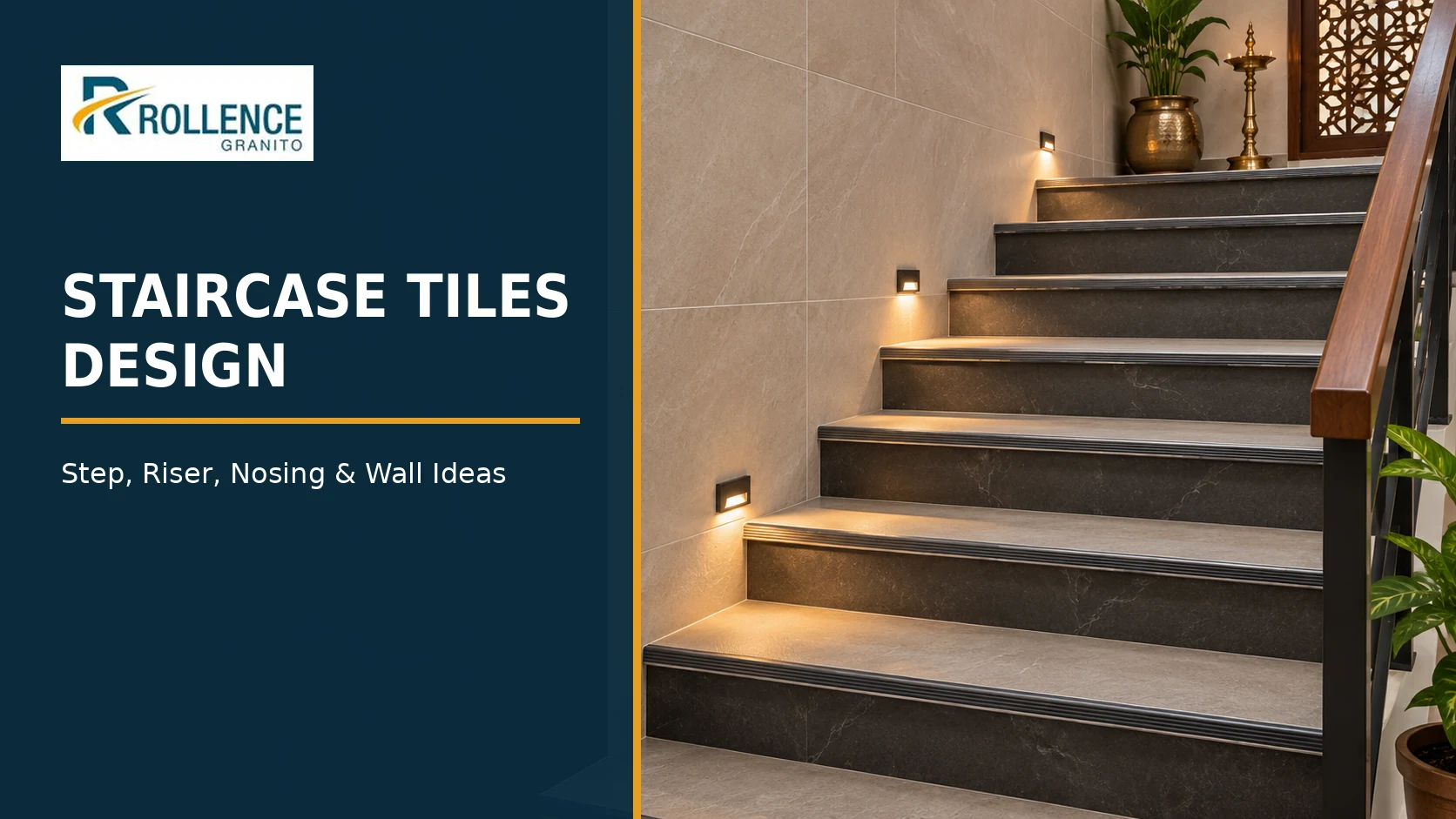
A staircase is the one place in a home where a tile choice can cause a fall, so staircase tiles design starts with safety and ends with looks. Use matte, anti-skid tiles on treads, a contrasting colour on risers or nosings so the edge is easy to see, and keep polished tiles off steps entirely.
Each part of a stair has its own job, so this guide plans them one by one: tread, riser, nosing, landing and stair wall. The finish rules come from tile finishes explained: glossy, high gloss, natural and matte, applied here to the tightest, riskiest surface in the house.
| Quick answer: For stairs, use a matte or GHR tile with R10 or higher grip indoors and R11 or higher outdoors, cut from 600x600 or 600x1200 floor tile. Make the nosing visible with a contrast strip or groove. Buy 12 to 15 per cent extra for cuts, and never use glossy, polished or satin matte tiles on steps. |
What are the parts of a staircase, and what does each need?
Each part of a staircase meets a different stress.
| Part | What it faces | Tile direction |
|---|---|---|
| Tread (the step you walk on) | Footfall, slip risk | Matte, anti-skid, scratch resistant |
| Nosing (the front edge) | Impact, wear, visibility | Grooved or contrast strip, strong body |
| Riser (the vertical face) | Kicks, scuffs | Same tile or contrast tile |
| Landing | Turning, resting, furniture | Same as floor tile |
| Stair wall | Scuffs, hands, shoes | Dado or full wall tile |
| Skirting (stepped) | Mop knocks | Cut from the floor tile |
Residential stairs in India normally have a tread of at least 250 mm and a riser of up to about 190 mm, in line with National Building Code norms. Those two numbers decide how your tile is cut.
Which tile is best for stair treads?
The tread takes the most feet and the most risk, so it gets the strictest choice.
Pick a matte, textured or GHR surface in vitrified tile. A GHR (glaze high resistance) face has a stone-like texture and holds up on high-traffic floors indoors and outdoors. Matte finishes give high scratch resistance and grip, and they are the usual indoor choice.
Slip rating is the check. Look for DIN 51130 R10 or above for indoor treads, and R11 or above for outdoor steps. If the staircase gets wet from rain or washing, go to R11 or R12.
Avoid glossy, high-glossy, polished PGVT and satin matte tiles on treads. They are slippery, especially with socks or wet shoes, and children and elders are most at risk. A look at where matte tiles outperform gloss is in the top 10 matt finish tiles manufacturers in India.
For high-traffic indoor stairs in dry areas, a double charge tile resists scratches well, but it comes in limited patterns and should never be used outdoors or on wet steps.
How should you cut tiles for treads and risers?
Treads and risers are usually cut from 600x600 or 600x1200 floor tiles. A 600x600 tile yields two 300x600 treads, and a 600x1200 yields two 300x1200 treads. Risers of 150 mm come from strips cut off the same tile, four to a 600x1200 piece.
| Stair part | Typical cut size | Source tile |
|---|---|---|
| Tread | 300 x 1000 to 1200 mm | 600x1200 cut in half |
| Riser | 150 x 1000 to 1200 mm | 600x1200 cut in strips |
| Landing | Full tile | 600x600 or 600x1200 |
| Skirting | 100 x 600 mm stepped | Floor tile offcuts |
Cut quality matters at the edge. A rough cut chips and shows. Ask the tiler to cut with a wet saw and ease the front edge slightly. Full body tiles, in which colour runs through the tile, suit stair edges because a chip does not show a different colour underneath.
How can the nosing be made visible and safe?
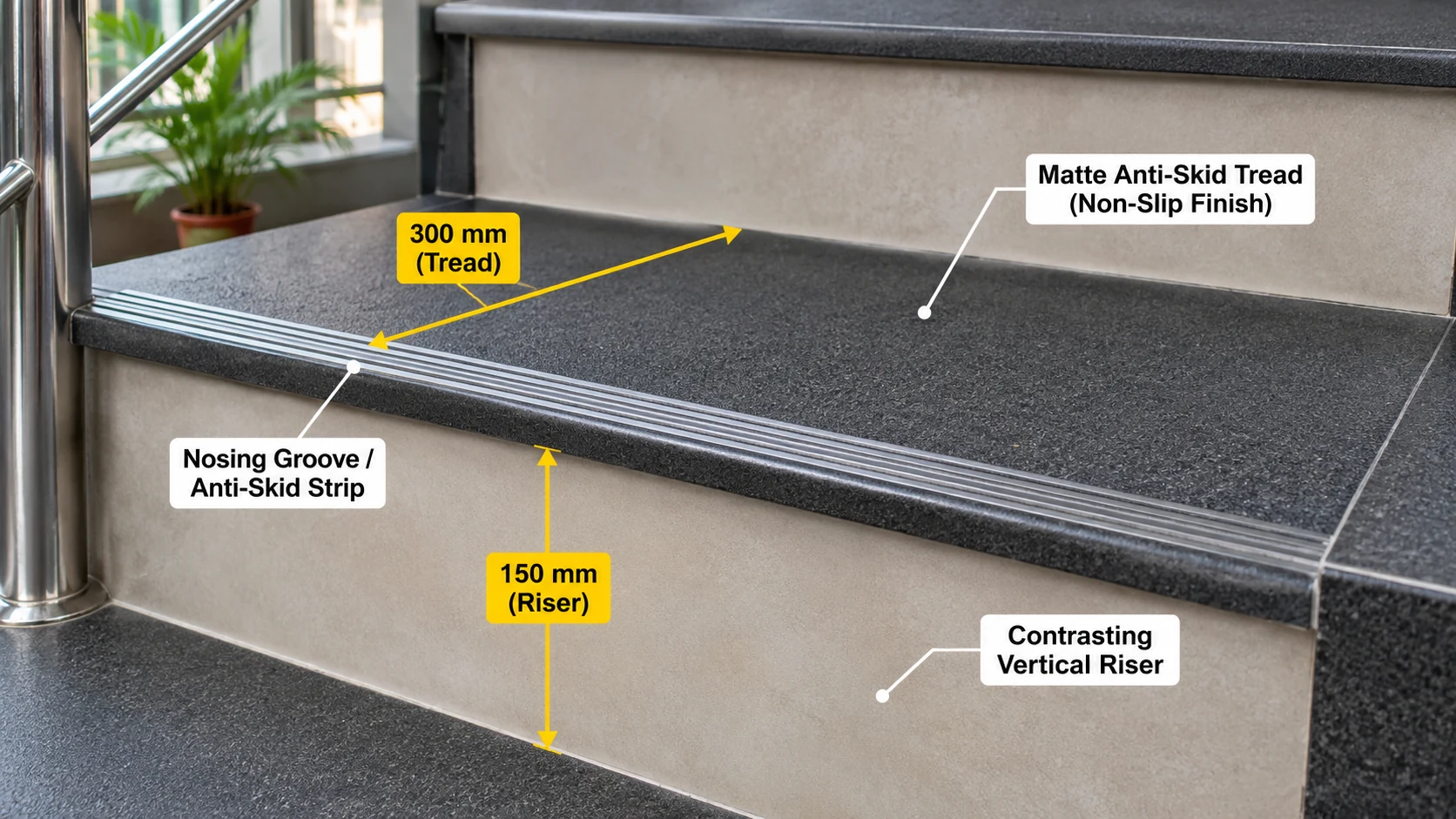
A stair nosing is the front edge where most missteps happen. A clear nosing helps eyes and feet find the edge.
There are three ways to build it. A grooved edge cut in the tile gives grip with no extra part. A contrast strip of a different tile colour on the first 40 to 50 mm of the tread marks the edge for elders. A metal or rubber nosing profile adds a hard edge and a groove, and it works well on outdoor steps.
Round the edge a little. A sharp tile corner chips and hurts.
For homes with elders or children, make the contrast strong. A pale tread with a dark edge, or the reverse, is easy to read in dim light.
What riser and colour combinations work?
Risers are the easy place to add colour, because nobody walks on them.
Same tile, tread and riser
This is the quietest look. It works with large, plain tiles and makes the stairs look like one block.
Contrast riser
A darker riser under a lighter tread makes each step visible and gives the staircase a rhythm. Grey and charcoal under beige is a safe pair.
Wood-look tread, plain riser
A wood-look tread on a vitrified body, with a white or pale riser, gives warmth and a clean edge. The wood-look surface is printed, so it resists water and wear.
Patterned riser
A printed pattern tile on the riser adds a bright accent. Keep the tread plain so the patterned face does not hide the edge.
For help with colour mood across the home, tile colour psychology for interior spaces explains how light and dark tones change the way a space feels.
Which tiles suit the stair wall?
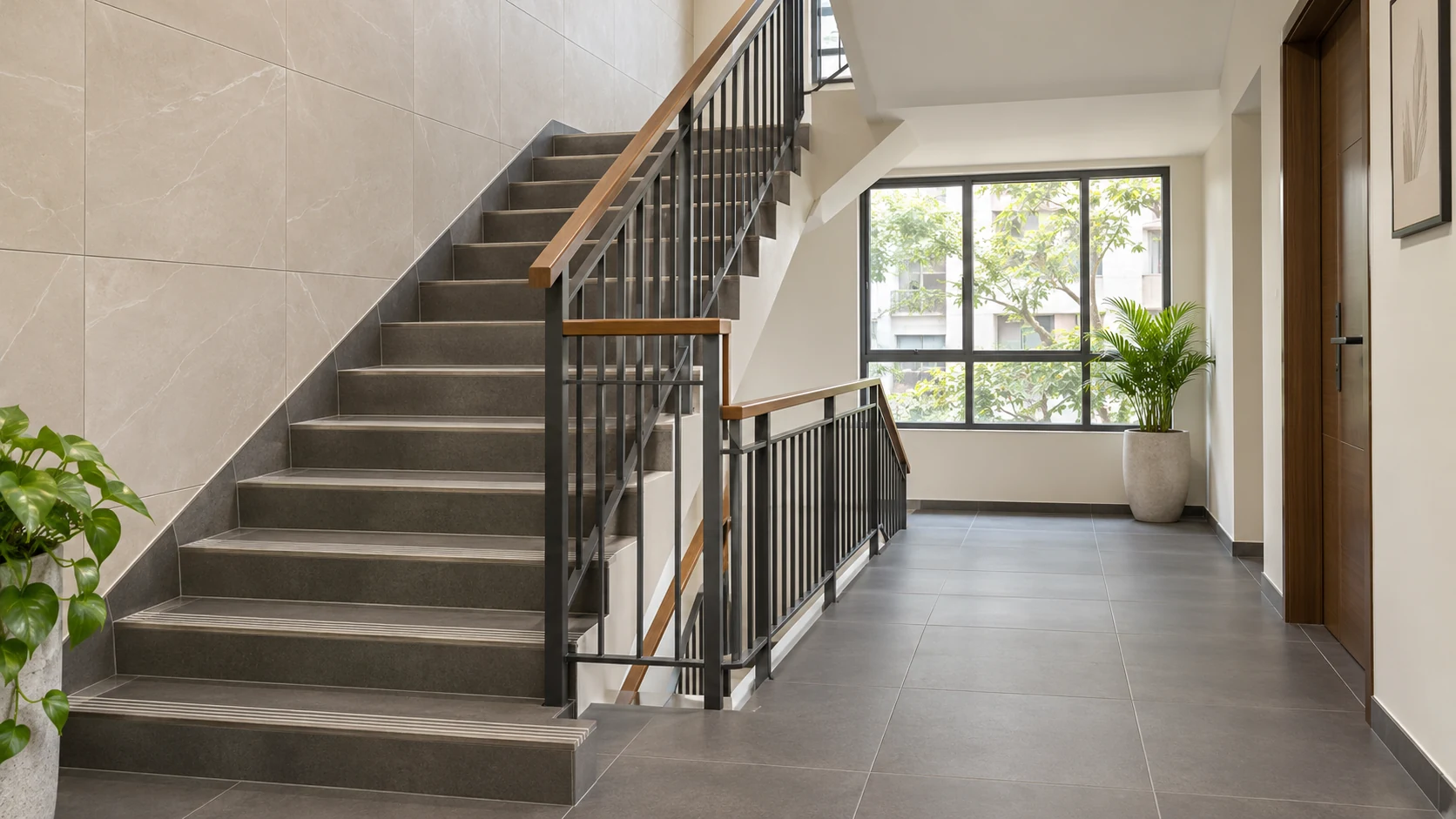
The wall along a staircase takes scuffs from shoes, bags and hands. A tile dado to about 1,000 mm protects it, and a full-height tile makes a feature wall.
A large tile on the stair wall gives a clean, joint-free surface. A matte marble-look or stone-look tile in a pale shade reflects light into the stairwell. Large-format cladding is also useful where the wall is double height, since fewer joints mean less work at height.
Stepped skirting should be cut from the floor tile, 100 mm tall, following the slope of the stair. A tidy skirting hides the join between wall and step and protects the paint.
| Stair wall option | Height | Pros | Care |
|---|---|---|---|
| Dado in wall tile | to 1,000 mm | Protects from scuffs | Plan the top edge |
| Full-height tile | floor to ceiling | Feature wall, easy wipe | Needs good fixing at height |
| Stepped skirting | 100 mm | Cheap, neat | Needs precise cuts |
How much tile does a staircase need?
Count the area of treads, risers and landings, then add wastage. For a straight flight of 15 steps, 1,000 mm wide, with a 300 mm tread and 150 mm riser:
Tread area is 15 x 0.30 x 1.0 = 4.5 sq m, and riser area is 15 x 0.15 x 1.0 = 2.25 sq m. The total is 6.75 sq m, or about 72.6 sq ft. Add a landing and 12 to 15 per cent wastage, and the order comes to about 85 to 90 sq ft before the landing.
Cut-heavy work like stairs wastes more than flat floors. Add the higher range if the stair turns or has winders.
What do architects and builders need to know?
Architects check riser and tread consistency, since a variation of more than 5 mm between steps in a flight can cause a stumble. They also check the slip rating of the tread tile and the contrast of the nosing.
Builders confirm that tile cuts match the finished stair size after screed. Order all tiles from one batch, because shade differences are easy to see on a stair where tiles sit close together.
Villa developers abroad use large wall tiles for stairwell cladding. Importers in Egypt who compare a 1200x1800 porcelain tiles Egypt supplier for double-height lobbies look at thickness, tolerance and shade consistency, and Rollence tests every batch to ISO 10545 before dispatch.
For commercial staircases in offices and malls, the case for hard-wearing tile is in why porcelain tiles are best for commercial flooring.
What changes for outdoor stairs, winders and spiral stairs?
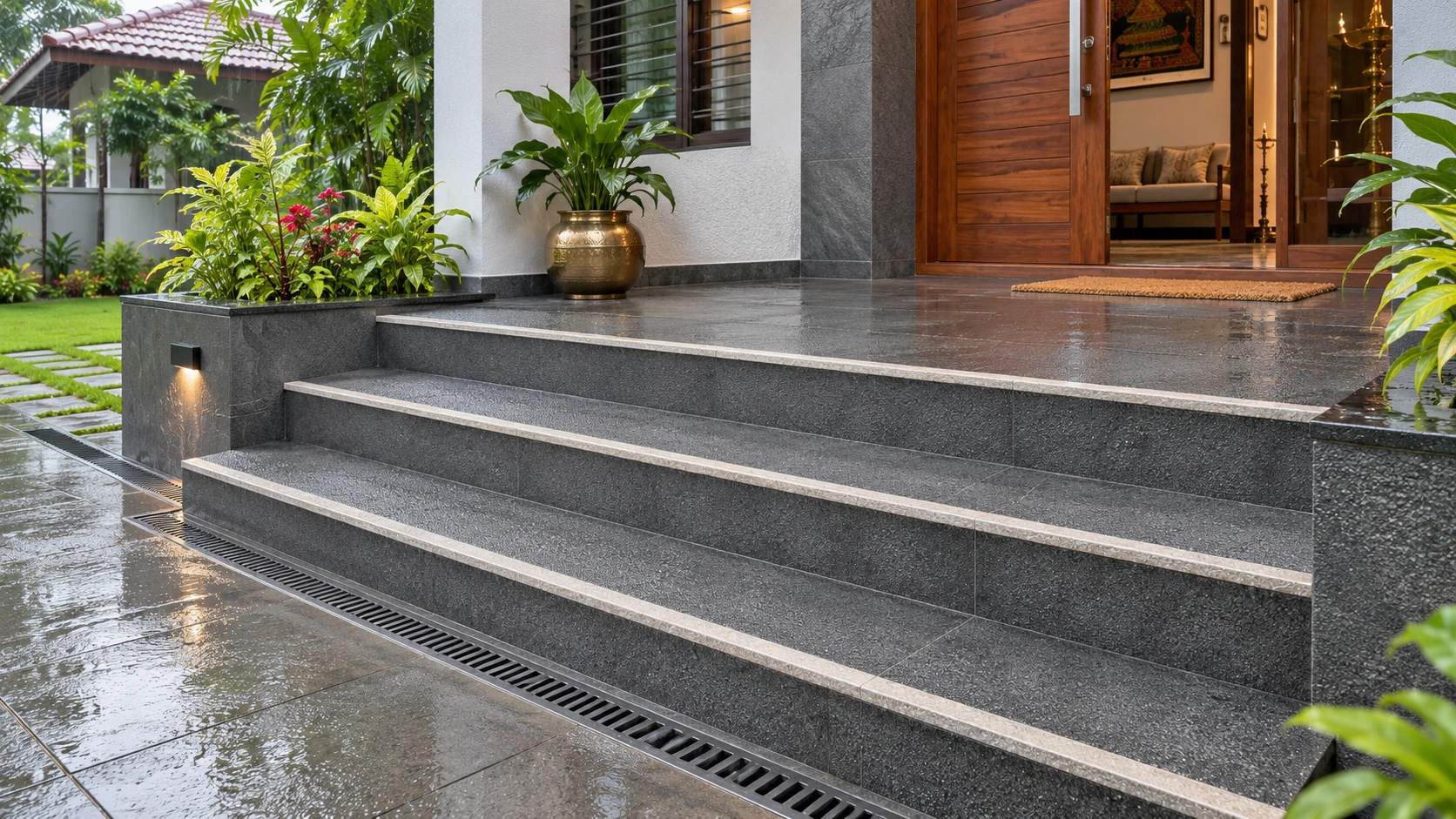
Outdoor stairs get rain, sun and dust, so the grip target rises to R11 or R12 and the tile must be matte or GHR with low water absorption. Slope each tread slightly toward the outer edge, about 1 to 2 per cent, so that water runs off and does not stand on the step.
Winders, which are pie-shaped steps at a turn, need many angled cuts. Plan for 15 to 20 per cent wastage and ask the tiler to template each step before cutting. A paper pattern for each winder saves expensive tile.
Spiral stairs are usually steel or concrete with small treads. Tile them with small-format pieces cut from a floor tile or use a pre-made step tile, and always add a grip strip at the edge. Large tiles cut into small wedges chip easily.
How do lighting and handrails work with the tile?
Stairs need light on the steps, not only on the landing. Low-level step lights or a strip light under the nosing show each edge, and a light-coloured nosing strip catches the glow.
Handrails should be easy to reach and should not be hidden by a tile feature wall. Fix the rail brackets to the wall before the wall tile if the position is fixed, or drill the tile with a diamond bit if it is fixed later. Seal the hole edges to stop water from entering.
Choose tile colours that keep a clear contrast between wall, tread and riser. If everything is the same pale grey, depth is hard to read in dim light, and that is when missteps happen.
What are the common staircase tile mistakes?
Using a polished tile on treads is the first. It looks fine and is slippery in socks.
Skipping the nosing detail is the second. A plain square edge chips and is hard to see.
Using thin tiles on wide spans is the third. A tread must sit fully on its mortar bed with no hollow spots.
Ignoring riser height variation is the fourth. Fix the stair dimensions before ordering tile.
Not testing grip is the fifth. Wet a sample and walk on it before you order.
FAQs on staircase tiles design
Which tile is best for stairs?
A matte or GHR vitrified tile with R10 or higher slip rating indoors and R11 or higher outdoors. Avoid glossy and polished tiles.
Can I use the same tile on stairs and floor?
Yes, if the floor tile is matte and anti-skid. Cut treads and risers from the same tile for a continuous look.
What size tile is used for stair treads?
Treads are cut from 600x600 or 600x1200 tiles to about 300 mm deep. Risers are cut to about 150 mm.
How do I make stairs safer for elders?
Use matte tiles, a contrast strip on the nosing, and good lighting. A grooved edge adds grip.
How much extra tile do stairs need?
Add 12 to 15 per cent, since cuts and edge chips are common.
Can I tile the stair wall with large tiles?
Yes. A large matte tile gives a clean wall with few joints, but it needs proper fixing at height.
Planning staircase tiles with Rollence
Send your stair plan and preferred finish to info@rollence.in and the Rollence team can suggest a size and matte or GHR surface from its range. Rollence is among the porcelain tiles manufacturers in Morbi, with GVT and PGVT made at its own factory in Matel.
Featured Tile Designs



Ready to Secure High-Performance Tiles for Your Project?
Get physical samples across our premium porcelain series, plus access to expert advice, to lock your scheme with confidence.