


Choose bedroom floor tiles in three steps: size first, colour second, finish last. For most Indian bedrooms, a 600x1200 tile in a warm neutral with a matte or wood-look face gives the best mix of look, grip and cost.
Each step has a clear rule, and the rules below are sorted in the order a buyer actually decides them. The size logic comes from how to choose the right tile size for every space, and colour follows tile colour psychology for interior spaces.
| Quick answer: Use 600x600 in bedrooms up to about 12 ft, 600x1200 or 800x1600 in larger rooms, a warm neutral shade, and a matte or wood-look face. Keep glossy and polished tiles out of children's and elders' rooms, and buy 8 to 10 per cent extra. |
Step 1: Which tile size suits your bedroom?
Size controls how busy the floor looks. Smaller tiles mean more joints, and more joints make a room look divided. Larger tiles give a calmer floor but need a flat base and careful layout.
| Bedroom size | Best tile size | Tiles for 144 sq ft (12x12 ft) incl. 8% wastage |
|---|---|---|
| Up to 10x12 ft | 600x600 | about 41 |
| 10x12 to 12x14 ft | 600x1200 | about 20 |
| 12x14 ft and above | 800x1600 | about 12 |
| Any size, plank look | 200x1200 wood-look | about 61 |
The counts assume a straight layout. A 600x1200 tile covers 0.72 sq m, and an 800x1600 tile covers 1.28 sq m, so the bigger tile cuts the number of joints by more than half.
Large tiles need a flat floor. If the slab is uneven by more than 3 mm over 2 m, level it before laying, or the tile edges will lift and the floor will look wavy.
If your bedroom opens into a living room, match the tile size in both rooms. Using one tile family across both rooms keeps the joins clean and the flat looking larger.
Step 2: Which colour works for a bedroom floor?
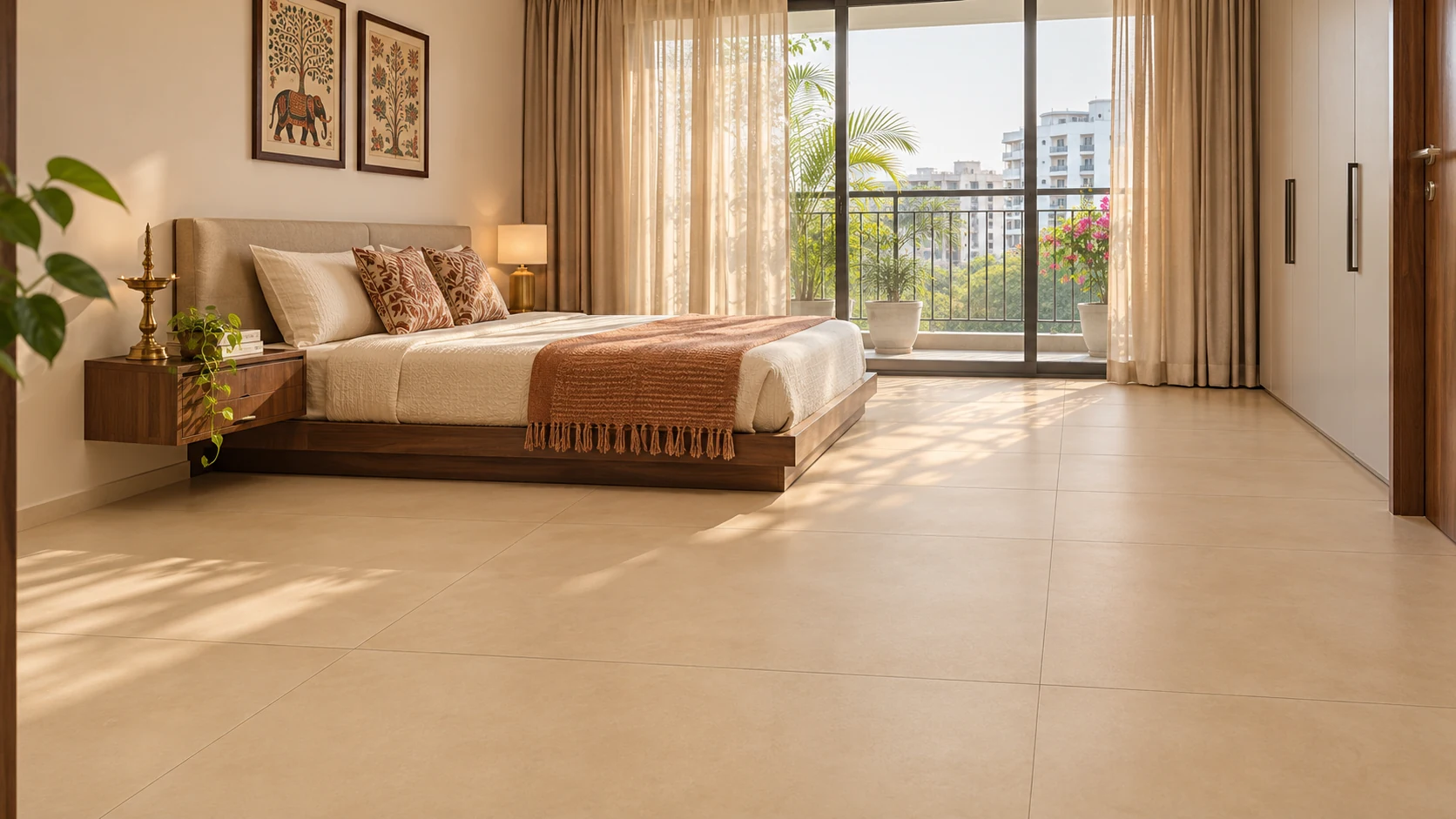
Pick colour by the light the room gets, not only by taste. A north-facing room with soft light looks cold in grey, and a west-facing room that heats up looks harsh in a white floor.
| Room light | Best floor colours | Avoid |
|---|---|---|
| North-facing, soft | Warm beige, sand, light wood | Cool grey, blue-grey |
| East-facing, bright morning | Light grey, ivory, cream | Very dark brown |
| West-facing, hot evening | Mid-tone beige, greige | Pure white, glaring cream |
| Small or dim room | Light warm neutrals | Dark tiles throughout |
Neutrals are the safe core. Cream, ivory and beige pair with almost any wall colour and bed frame. Wood-look tiles add warmth to flats that have plain walls, and mid-greys give a calm, hotel-like look.
For colour pairing with walls and furniture, best tile colour combinations for living rooms works equally well for bedrooms, since the logic of undertones is the same.
Keep the floor lighter than the furniture. A dark bed on a dark floor merges and loses shape, while a dark bed on a light floor reads clearly.
Step 3: Which finish feels right underfoot?
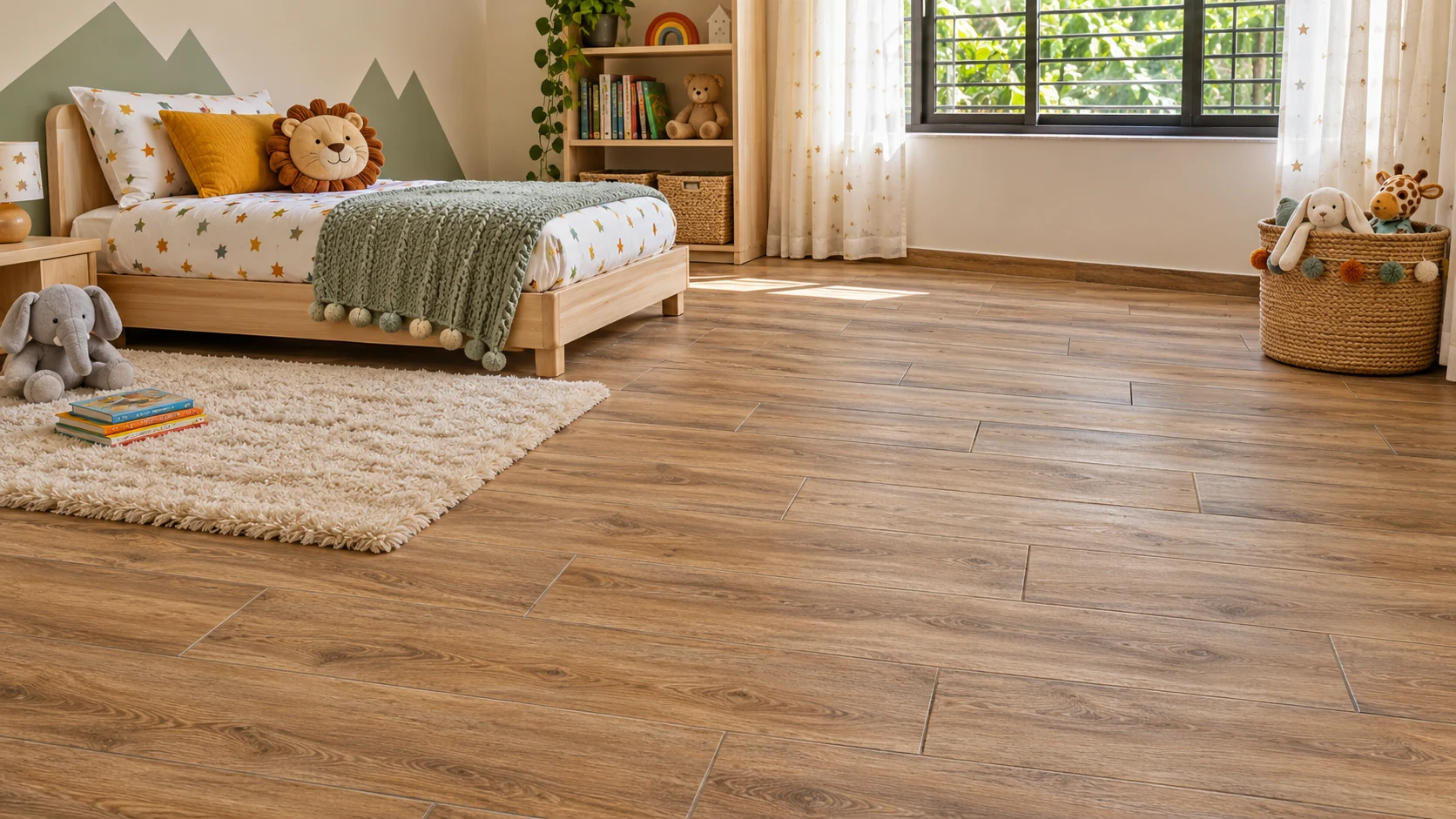
Bedrooms are dry rooms, so the finish decision is about feel, cleaning and safety, not water.
Matte tiles are the practical pick. They hide footprints, stay grippy with socks and give a soft look. Wood-look tiles carry the print on a vitrified body, so they feel warm and clean easily.
Glossy and polished tiles show footprints, dust and slippers' marks. They also feel slippery on socks, which matters in a room used by children or elders. If you like the shine, keep it to a master bedroom used by adults.
For a comparison of the two gloss levels, glossy vs high gloss tiles covers how each reflects light and where it shows wear.
Double charge tiles hold scratches well on polished floors, and they suit dry indoor rooms. They are limited in patterns, so check that the colour you like is available.
| Finish | Feel | Cleaning | Best use |
|---|---|---|---|
| Matte | Soft, grippy | Easy | All bedrooms |
| Wood-look matte | Warm | Easy | Kids' and guest rooms |
| Posh matte | Looks like Italian marble | Easy | Master bedrooms |
| Glossy or polished | Shiny, slippery on socks | Shows footprints | Adult-only rooms |
| Double charge | Strong, polished | Easy | Dry high-traffic passages |
Which common myths mislead bedroom tile buyers?
Myth: a glossy floor makes a room look bigger. Fact: gloss reflects light, but it also shows every footprint and glare spot. A large, light matte tile makes a room look bigger with less upkeep.
Myth: dark floors are always bad for small rooms. Fact: a dark floor with light walls and good lighting can look rich. The trouble is a dark floor with dark walls and no daylight.
Myth: bigger tiles always cost more. Fact: rates per sq ft rise with size, but fewer joints, less grout and faster laying cut part of the difference. A 600x600 GVT sells at about Rs 40 to Rs 75 per sq ft, and an 800x1600 at about Rs 80 to Rs 140 in 2026 branded listings, ex-GST.
Myth: wood-look tiles scratch like wood. Fact: they carry a printed face on a vitrified body, so they resist scratches and water.
How do you plan the layout and joints?
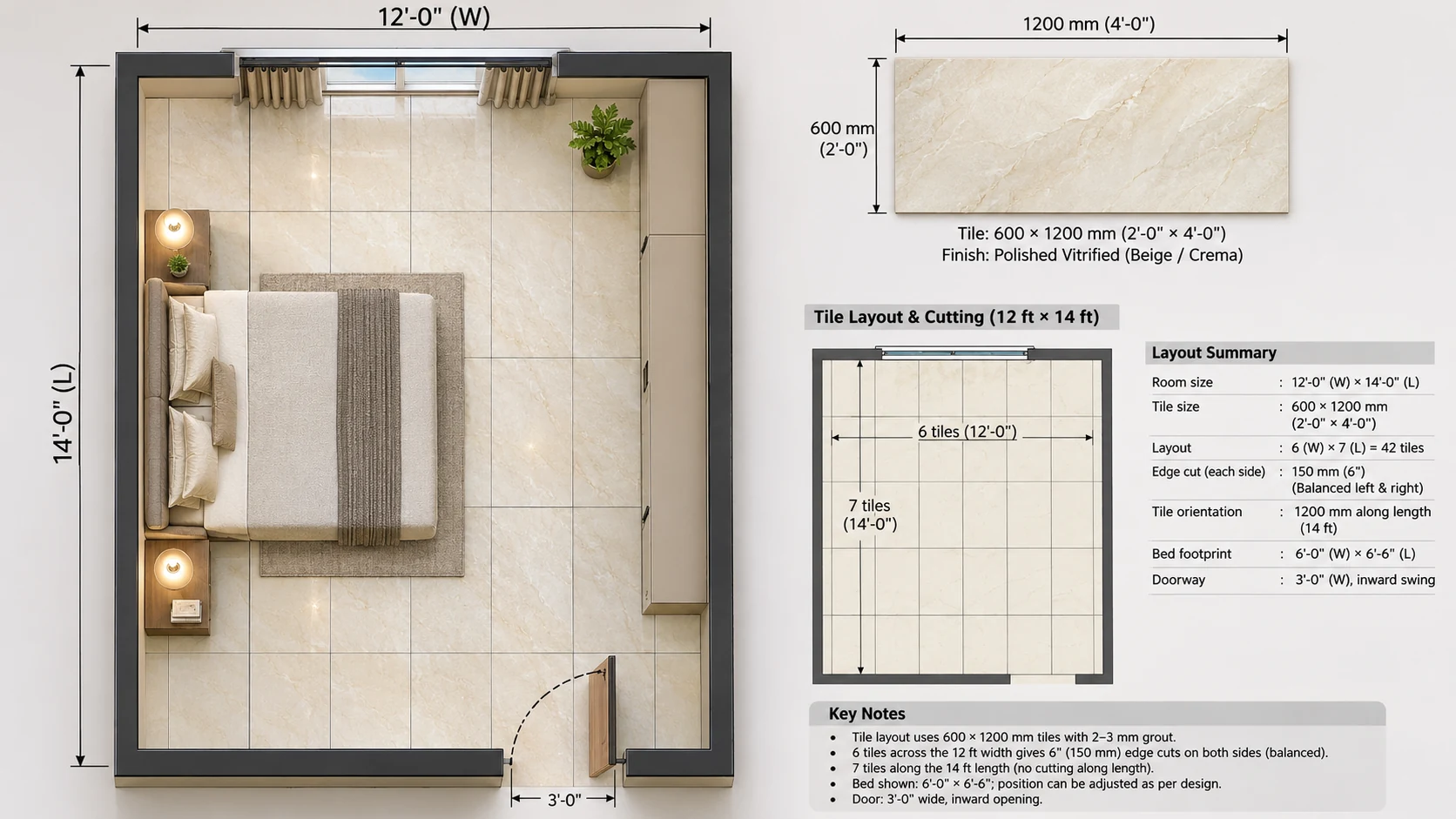
Start the layout from the doorway, so the first full tile sits where people see it. Keep cut tiles under the bed and wardrobes, where nobody looks.
For 600x1200 tiles, use a one-third offset instead of a half offset. A half offset can show slight bowing in long tiles, and a one-third pattern hides it.
Use 2 to 3 mm joints for rectified tiles, and match the grout to the tile. A skirting cut from the same tile gives a clean finish at the wall.
What do architects and dealers watch for in bedrooms?
Architects check that the bedroom threshold lines up with the passage tile, and that no step trips someone at night. They also keep a slim expansion gap at the walls, covered by skirting.
Dealers and contractors check batch consistency, since shade differences are more visible in a quiet bedroom than in a busy hall. Ask for the entire order from one batch.
Buyers overseas make the same checks. Importers in Egypt who compare a 1200x1200 porcelain tiles supplier in Egypt for villa and apartment floors look at shade consistency, calibre and pallet packing, and Rollence tests every batch to ISO 10545 before dispatch.
How should the floor change from one bedroom to another?
Each bedroom in a home has a different user, and the tile can reflect that.
The master bedroom is the place for a richer look. A large 800x1600 tile in a posh matte or a soft marble-look gives a calm, hotel-like floor, and a double charge or good GVT body keeps the surface clean under years of use.
The children's room needs grip and easy cleaning. A matte or wood-look tile in a mid-tone hides spills and crayon marks, and it gives a warmer surface for floor play. Round corners on skirting and avoid high polish.
The guest room can be neutral and quiet. A light beige 600x600 or 600x1200 matte tile works with any bedding, and it is a safe pick if you plan to rent or resell the home.
The elders' room needs safety above all. Choose a matte tile with a good grip rating, keep the floor level with the passage, and avoid dark-and-light patterns that look like steps to tired eyes.
| Room | Tile direction | Why |
|---|---|---|
| Master | Large posh or marble-look matte | Calm, fewer joints |
| Children | Matte or wood-look mid-tone | Grip, hides marks |
| Guest | Light neutral matte | Works with any bedding |
| Elders | Matte, level, plain | Safety, easy to read floor |
How do you handle skirting, thresholds and the bathroom door?
Skirting protects the wall from mops and gives a clean edge. Cut it from the floor tile in 100 mm strips, or use a 75 mm strip for a slimmer look. Fix it with a small gap at the floor so that the tile can move.
At the doorway, line up the bedroom floor with the passage floor. If the two tiles differ, put the change under the door leaf, where it hides. A small level difference should be eased with a slim threshold strip, never a sharp step.
At the attached bathroom, keep the bathroom floor about 15 to 25 mm lower than the bedroom floor, or use a raised threshold, so water does not creep into the bedroom. The bathroom floor must be matte and anti-skid, and the bedroom tile can differ from it.
Does the floor tile affect warmth and noise?
Tile feels cooler underfoot than timber, which many people notice in winter. A rug beside the bed fixes this without changing the floor. Wood-look tiles look warm, though they have the same temperature as other vitrified tiles.
Tile is also harder than carpet and reflects sound. In a bedroom, soft furnishings such as curtains, a rug and upholstered furniture absorb echo. Large-format tiles with fewer joints give a quieter look, and a full mortar bed under the tile removes the hollow sound that some floors give.
What mistakes should you avoid in bedroom tiles?
Choosing tile in a showroom light is the first. Take a sample home and look at it in your room at morning and night.
Ordering too little is the second. A later order often comes from a new batch with a different shade.
Using a high-gloss tile in a child's room is the third. Slippery floors and running children do not mix.
Ignoring the skirting is the fourth. A skirting cut from the same tile gives a cleaner room than a plastic or wooden strip.
FAQs on bedroom floor tiles design
Which tile is best for a bedroom floor?
A matte or wood-look vitrified tile in 600x600, 600x1200 or 800x1600, depending on room size. It hides footprints and keeps good grip.
What tile size is best for a small bedroom?
600x600 is the safe choice for rooms up to 10x12 ft. A 600x1200 can also work and gives fewer joints.
Which colour is best for bedroom floor tiles?
Warm beige, ivory and light wood tones suit most rooms. Pick lighter shades for dim rooms and mid-tones for rooms with hot evening sun.
Are wood-look tiles good for bedrooms?
Yes. They give a warm look, resist water and scratches, and clean easily. The usual plank size is 200x1200.
Can I use glossy tiles in a bedroom?
You can, but they show footprints and feel slippery on socks. Matte tiles suit bedrooms better, especially for children and elders.
How much extra tile should I buy for a bedroom?
Buy 8 to 10 per cent extra for a straight layout and 12 per cent for diagonal or plank layouts.
Planning your bedroom floor with Rollence
Send the room size and light direction to info@rollence.in and the Rollence team can suggest a size and finish from its range. Rollence is among the porcelain tiles manufacturers in Morbi, and its GVT range runs from 600x600 to 1200x2800 mm in matte, GHR and other finishes.
Featured Tile Designs





Ready to Secure High-Performance Tiles for Your Project?
Get physical samples across our premium porcelain series, plus access to expert advice, to lock your scheme with confidence.